
Key stats
Source: Yahoo Finance. Data as of 11/12/25.
About Waste Management Inc
Waste Management, Inc., through its subsidiaries, provides environmental solutions to residential, commercial, industrial, and municipal customers in the United States, Canada, Western Europe, and internationally. It offers collection services, including picking up and transporting waste and recyclable materials from where it was generated to a transfer station, recovery facility, or disposal site; owns and operates transfer stations; and owns, develops, and operates landfill gas-to-energy facilities that produce renewable electricity and renewable natural gas. It also operates materials processing and commodities recycling services, including cardboard, paper, glass, metals, plastics, construction and demolition materials, and other recycling commodities are recovered for resale or redirected for other purposes; recycling brokerage services, such as managing the marketing of recyclable materials for third parties; and other strategic business solutions. In addition, the company collects recyclable food and yard waste, as well as markets and sells mulch, compost, soil amendments, and renewable energy; offers remediation and construction, and industrial waste services; and manages and markets fly ash. Further, it provides Regulated Waste and Compliance Services (RWCS), which offers compliance programs, as well as collection, processing, and disposal of regulated and specialized waste, including medical, pharmaceutical, and hazardous waste; and Secure Information Destruction (SID) services that includes the collection of personal and confidential information for secure destruction and recycling of sorted office paper. The company was formerly known as USA Waste Services, Inc. and changed its name to Waste Management, Inc. in 1998. Waste Management, Inc. was founded in 1968 and is based in Houston, Texas.
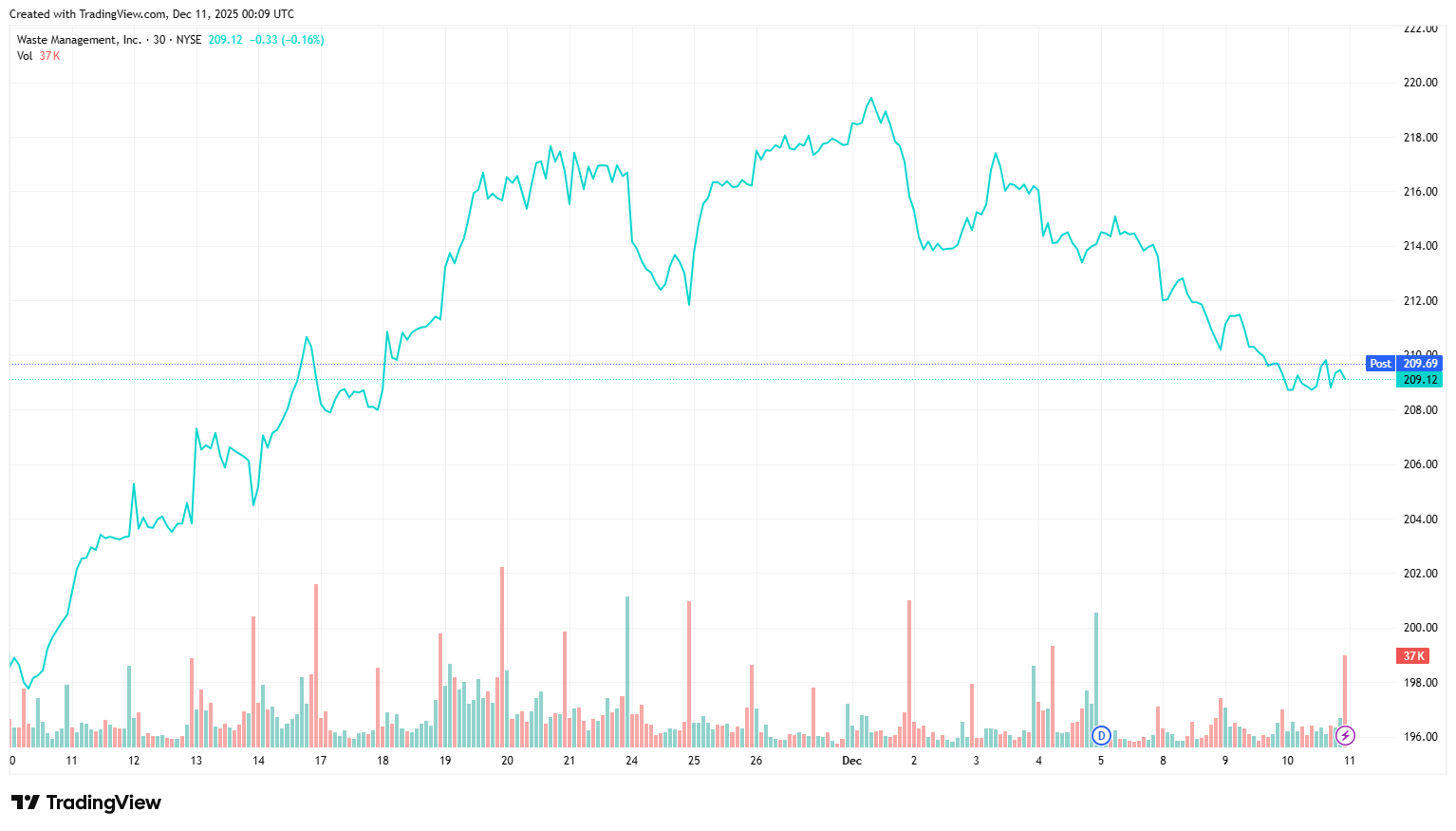
Price Performance
Growth Potential
- Essential service (waste collection, recycling, disposal and landfill services) with recession-resilience gives the company a defensive tilt making it an attractive investment in an uncertain environment.
- Structural industry tailwinds and high barriers to entry as waste and recycling industry is increasingly constrained by limited landfill capacity and regulatory hurdles for new disposal sites with the company owning hard-to-replicate assets (largest landfill network, transfer stations, fleets) while being vertically integrated (business model spans collection + transfer + landfill/disposal + resource recovery), provides benefit from pricing power across collection and disposal businesses.
- Strong pricing power (fee increases, contract escalators) along with cost and efficiency improvements (deploying technology like route optimisation, newer trucks, side-loading equipment etc. to reduce labour/asset cost per unit of waste collected) gives ability to expand margins.
- Strategic diversification and optionality in new growth areas with the company investing in renewable natural gas (RNG) from landfills and sustainable operations (command higher premium especially from ESG investors), consolidating through acquisitions and improving route efficiency via automation and technology (thus lowering cost base over time).
- Disciplined capital allocation strategy with a focus to sustainably grow its dividend, targeting a 40-50% FCF payout, maintain capex at 9.5-10.5% of revenue and resume buybacks once the leverage returns to 2.5-3.0x.
Key Risks
- Regulatory/environmental risks as landfills have long-term liabilities (closure, leachate, emissions) and increasing regulation (PFAS, waste diversion laws) which could increase capex or compliance costs.
- Execution risk in growth initiatives (investing in RNG, recycling, M&A).
- Cost/inflationary pressures from fuel, labor and equipment could squeeze margins.
- Lower commodity prices (decline in OCC and RIN prices) could impact earnings.
Frequently asked questions
This article is general information only and does not take into account your objectives, financial situation or needs. It is not a recommendation to buy or sell any security. Past performance is not a reliable indicator of future performance. Consider seeking financial, legal and taxation advice before investing.