
Our US semiconductor stock research is curated by the Sharewise equity analyst and research team, reviewed and updated monthly as the markets move.
US semiconductor stocks have attracted widespread investor attention on the back of escalating global demand, driven by increasing use in AI, data centres, electric vehicles (EVs), everyday devices and industrial equipment.
The US hosts many leading semiconductor design and equipment-making companies, and investing in American semiconductor stocks gives Australians exposure to a sector that is barely present in the local market.
US chip stocks have experienced strong momentum in recent times, but stock prices can be subject to sharp falls on the back of trending headlines, geopolitical tensions and changes to government policy. Company fortunes are also dependent upon the semiconductor supply-demand cycle, and this can affect different players in varying ways.
Independent research can help investors identify the best semiconductor stocks through detailed analysis, rather than focusing solely on recent share price movements, and assess their potential from a long-term perspective.
The US is home to many of the world’s leading semiconductor chip designers and makers of equipment used in their manufacture. Long-term, the sector is expected to continue expanding, driven by extensive use of chips in everything from AI to EVs and smart household appliances. US semiconductor stocks such as Nvidia (NVDA), Broadcom (AVGO) and Micron Technology (MU) have become widely held by both individual and institutional investors.
Currently, much chip manufacturing occurs in Asia, and many US semiconductor suppliers are dependent on them as part of their supply chain. The US government’s CHIPS and Science Act seeks to boost local semiconductor research and development and increase local manufacturing, which may drive further investor opportunity.
While investment in semiconductor stocks has trended up, there are risks to be aware of. The semiconductor sector is cyclical in nature, and individual stocks can be driven to over-valuation by hype. Other US policy initiatives - such as export controls and tariffs - have also had a disruptive influence on the market, impacting end markets and supply costs, and increasing overall investor uncertainty.

The US semiconductor sector includes companies providing chip design, manufacturing, memory, equipment and specialised components. The companies below represent some of the better-known semiconductor stocks operating across the value chain.
These companies are a representative selection that may warrant further research, rather than specific investment recommendations. Investors should consider how each stock fits with their individual investment goals, risk tolerance and broader portfolio.
Key activities: A semiconductor foundry that manufactures advanced semiconductors designed by other companies, for applications including AI, high-performance computing, automotive and industrial technology, as well as providing packaging-related services.
Why watch: Allows investment in the Asian manufacturing sector via a US listing; exposure to demand from a broad range of end markets including AI accelerators and high-performance computing, automotive and industrial applications.
Key activities: Manufactures memory chips, including DRAM, NAND and NOR, used in servers, smartphones, cars and other electronic devices.
Why watch: Exposure to the memory segment of the semiconductor industry, which has different dynamics from chip designers and foundries; broad product usage including data centres, enterprise storage, mobile devices, automotive and consumer applications.
Key activities: Designs GPUs, AI accelerators and other computing platforms used in data centres, gaming, professional computing and automotive applications. Its CUDA software platform also supports the development of applications that run on Nvidia hardware.
Why watch: Nvidia is one of the world's most prominent fabless semiconductor companies and the US’s largest market-cap semiconductor stock; has significant exposure to AI and accelerated computing; combines specialised chips and a large supporting software ecosystem.
Key activities: Makes the specialised equipment used by semiconductor manufacturers to print circuits onto silicon wafers. Supports the production of increasingly advanced chips, and provides metrology and inspection equipment that help manufacturers to monitor production.
Why watch: Provides technology that is critical to the semiconductor supply chain, meaning revenue is linked to capital spending by manufacturers, as well as end-use demand.
Key activities: Designs and manufactures analog, signal-processing and embedded-processing semiconductors, which manage electrical power and convert or process real-world signals, while its embedded products are designed for specific applications.
Why watch: Provides exposure to the analog and embedded semiconductor markets, which serve a broad range of electronic equipment for use across industrial, automotive, consumer and other applications; provides exposure to semiconductor cycles outside of computing and AI.
Key activities: Designs and manufactures Intel-branded processors for PCs, edge devices and data centres. Also develops manufacturing processes and advanced packaging for external customer chips via its Intel Foundry businesses.
Why watch: Exposure to both chip design and semiconductor manufacturing; highly recognised Intel brand; foundry operations provide access to a different value model.
Company details are current as of November 2026.
Semiconductor stocks in the US include companies working across a whole value chain to design, manufacture and supply chips for a wide variety of end uses, along with the equipment used to produce them. These businesses can have very different revenue drivers and can be impacted differently by the semiconductor cycle.
The semiconductor cycle: Rising end-use demand can drive customers to increase orders and build inventories of semiconductors, prompting manufacturers to expand production. Eventually, supply can exceed demand and customers begin working through excess inventory, causing chip prices, production and profits to fall. The demand cycle for one type of chip’s end-use can be different from another's, and cycles can affect different parts of the supply chain in varied ways.
Fabless chip designers: These companies design semiconductors but outsource manufacturing to specialist foundries. Revenue comes from selling designs and products, and performance can be impacted by the semiconductor cycle.
Integrated manufacturers: Some companies design and manufacture their own chips, giving them greater control over supplies and production. Their profitability can be affected by changes in chip demand, production costs and the utilisation of manufacturing capacity.
Foundries: Manufacture chips designed by other companies, and sometimes provide packaging services, which prepare chips for use. Performance depends upon customer demand and factory utilisation.
Semiconductor equipment makers: Supply the machinery and technology needed to manufacture chips. Revenue is driven by orders from semiconductor manufacturers and is sensitive to changes in manufacturers' capital spending plans.
Memory chip makers: Produce the memory chips used in computers, smartphones and data centres. Memory products are often standardised and subject to competition, and are particularly sensitive to cyclical fluctuations.
Analog and power chip makers: Produce chips that manage functions such as power, voltage, signals and energy conversion in electronic devices. These are often designed for specific end uses, so individual companies are affected by that industry’s demand cycle.
The US has a particular strength in semiconductor chip design and supply, but global manufacture is predominantly located in Asia. Taiwan Semiconductor Manufacturing Company (TSMC) is an interesting anomaly in that, while it manufactures in Taiwan, it has shares listed on both the NYSE and the Taiwan Stock Exchange (TWSE). Recent US government initiatives and tariffs aim to increase US manufacturing and reduce reliance on overseas supply.
Research, advisory, execution and corporate finance under one roof — with every recommendation backed by in-house analysis from our Chief Investment Officer, Rabih Ahmed, and his equity research team.
Every call is grounded in company fundamentals and technical analysis, with a stated thesis and defined entry and exit levels - so you know what you're buying and when to act.
Every client gets their own share advisor — a licensed professional who knows your holdings, tracks the market daily, speaks with our analysts every day, and is reachable during market hours and beyond.
Explore Share Advisory →Professional trading technology across ASX, US and global markets. Stop losses, take-profits and position sizing are set at entry, and every trade is executed only on your approval.
How execution works →Institutional-grade coverage of ASX small and mid-cap companies across healthcare, resources, technology and energy - stocks most retail research never reaches.
Access the research →In-person events and webinars featuring ASX-listed companies, where you can meet management and put your questions to them directly.
Explore the Investor Hub →Access to placements, IPOs and capital raisings through our corporate finance desk.
Explore Corporate Finance →When considering stock picks from amongst the US semiconductor stocks list, it is wise to look beyond recent share-price performance and earnings and consider broader underlying factors :
Industry cycle: Where does the company currently sit within the supply-demand cycle? Look at inventory levels, customer orders and order trends.
Customer concentration: Does the company rely heavily on a small number of large customers? What impact would it have to lose a major customer?
Gross margins: Are margins improving over time, and how do they compare with industry peers? Strong margins can indicate good efficiency or pricing power, while falling margins may signal increasing competition or weakening demand.
Research and development: Is the company investing enough in R&D to keep up with technological change, and is that investment producing commercially successful products?
Capital spending: For semiconductor manufacturers, what level of capital investment is required to meet demand, what is being invested, and how long before production capacity comes online?
Import/export controls and geopolitics: Are supplies or end markets affected by changes to tariffs or export controls? What impact could further geopolitical tensions with China have?
Valuation and future guidance: Is the current share price valuation in line with realistic growth targets, or has strong investor interest caused it to become overvalued? Stock prices can fall sharply if a company’s future outlook is weaker than investors expect, even after reporting strong earnings.
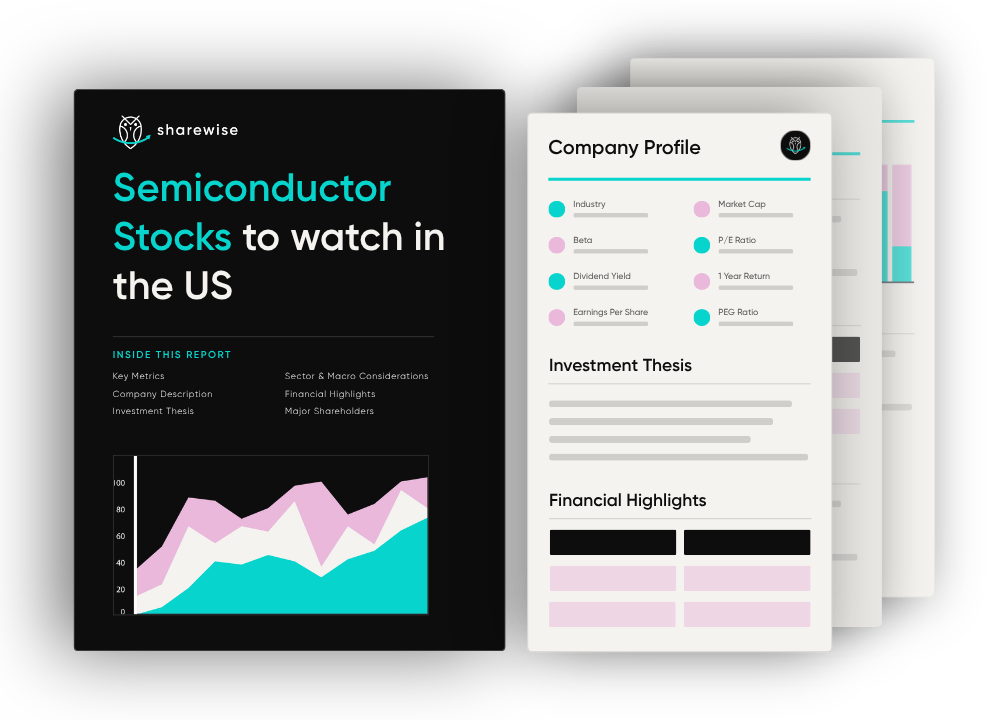
To help ensure you’re investing based on quality analysis, download our free report and speak to a specialist US share advisor.

From your first strategy session to ongoing advice and trade execution, here's what working with Sharewise looks like at every stage.
Become a member and get full access to our research, advisory and support - with clarity on exactly what's included from day one.
Start fresh or transfer an existing portfolio across - individual, joint, SMSF, company or trust, with access to ASX, US and global markets.
Your central hub: view your portfolio and open positions, read our research and market updates, and see every recommendation — on desktop or mobile, 24/7.
Sit down with your share advisor to walk through how Sharewise works and how we can support your investing with research-backed guidance grounded in fundamental and technical analysis.
Your advisor brings you opportunities across ASX and international markets as they arise, and trades are executed only on your approval.
As a client, you may be eligible for placements, IPOs and capital raisings sourced through our corporate finance desk.
The best US semiconductor stocks can provide Australian investors with exposure to key global players in a high-demand technology sector. However, these stocks can also carry risk, and some stocks are more speculative than others. Consider how the following may impact individual stocks:
Industry cycles and oversupply: Semiconductor demand can move through cycles of building inventory, then curtailing production. Periods of oversupply can lead to falling prices and earnings, even while long-term demand continues to grow.
High valuations built on AI expectations: Hype around expected growth in AI and other technologies can over-inflate current stock valuations. If investor sentiment changes, share prices can drop sharply, even if the company's underlying business remains strong.
Export controls, tariffs and US-China tensions: Changes to US government policy - such as tightening controls on chip exports to China, and import tariffs that impact supply chain costs - and the uncertainty they generate can have a marked effect on semiconductor stock prices. Geopolitical tensions create further investor uncertainty.
Supply chain concentration: Semiconductor manufacturing is heavily concentrated in Taiwan and Asia, and disruptions to supply in these areas or geopolitical tensions can have significant follow-on effects for US semiconductor companies.
Customer concentration: Some semiconductor companies rely heavily on a relatively small number of large customers. The loss of a major customer can significantly impact their revenue and cause stock prices to fall
Heavy capital spending: Semiconductor manufacturing requires substantial investment and several years to become productive, creating risk that market conditions or demand expectations may change before new capacity comes online.
Currency movements: Changes in AUD-USD exchange rates can affect the Australian-dollar value of investments and any dividend returns.
These risks can be managed, but not eliminated, through diversification across semiconductor stocks, research into individual companies, and by having chip stocks as a small portion of overall share holdings.

When considering semiconductor stocks to buy, keep these investment tips in mind:
Diversify: Spread exposure across multiple companies and different parts of the value chain to reduce the impact of demand-supply cycles and investor sentiment around individual stocks.
Take a long-term view: Invest based on sound underlying fundamentals and ride out short-term volatility, rather than trading based on current investor sentiment or headlines,
Portfolio balance: Keep US semiconductor stocks as one part of your overall portfolio, balanced against other investments such as income-producing assets, lower-risk stocks and non-US investments.
Lodge your W-8BEN form: If your US semiconductor stock pays a dividend, it will generally be subject to withholding tax of 30%. Australian investors can lodge a W-8BEN form with their broker before the first dividend is paid, in order to have this tax reduced to 15%.
To help ensure you’re investing based on quality analysis, download our free report and speak to a specialist US share advisor.

US semiconductor stocks are shares in companies involved in designing, manufacturing or supplying semiconductors and related equipment. They include chip designers, foundries, memory manufacturers, analog and power chip makers, and semiconductor equipment companies listed on US stock exchanges.
Chip designers develop the architecture and specifications of semiconductors, while manufacturers produce the physical chips. A semiconductor company may perform one or both functions. Fabless companies such as Nvidia outsource manufacturing to foundries such as TSMC, while integrated manufacturers such as Intel both design and manufacture chips.
A number of factors drive the volatility inherent in semiconductor stocks. Firstly, the sector is cyclical, with periods of strong demand and shortages followed by excess inventories and weaker prices. Additionally, individual company share prices can be sharply affected by changing growth expectations, technological evolution, changing competition, supply chain disruptions, capital spending and geopolitical factors.
Australians can buy US semiconductor stocks through a stockbroker or online broking platform that provides access to US markets.
Semiconductor stocks can appeal to investors seeking exposure to technology and long-term growth in areas that use chips, and who have some tolerance for risk and volatility. Whether they are a suitable investment depends on an investor's goals, risk tolerance, time horizon and broader portfolio.
US export controls can restrict the sale of certain advanced chips and related technology to particular countries, notably China. In 2025, restrictions were placed on Nvidia’s H20 and AMD’s MI308 chips, but then licences were granted for some sales to approved Chinese customers. Investor uncertainty around which products will be restricted, how long licences will remain in place, and whether policies might change in future can drive stock price volatility.
Get detailed analysis of US semiconductor stocks that goes beyond the headlines to explore industry cycles, risk factors and individual growth outlooks.
Subscribe for updates for institutional research, webinars and events across ASX, US and global markets.
Full-service share advisory and stockbroking for Australian investors.
Level 9, 68 Alfred St S, Milsons Point NSW 2061
Sharewise Group Pty Ltd (ABN 22 664 471 247) is a Corporate Authorised Representative (No. 001302760) of Sharewise Compliance and Administration Pty Ltd (AFS License No. 280420).
The information provided by Sharewise is of a general nature only and does not take into account your personal financial situation, objectives, or needs. The information presented is for informational purposes only. Trading in stocks and other securities carries risks, including the potential loss of your invested capital. The market is subject to various factors that can impact the value and performance of securities. Some information on our website may be sourced from third parties believed to be reliable. While we make every effort to ensure accuracy, Sharewise cannot guarantee the completeness, accuracy, or timeliness of such information and assumes no responsibility for any errors or omissions. We do not guarantee the performance or returns on any investments or financial products mentioned, and past performance is not a guarantee of future results. Any investment decisions you make are your own responsibility, and you should consider seeking professional advice before making any financial decisions.
By submitting your details or downloading our material, you consent to Sharewise contacting you with related information.