
Our oil stock research is curated by the Sharewise equity analyst and research team, reviewed and updated monthly as the markets move.
Australia's listed energy sector has spent the past few years shifting from growth to capital discipline. Producers that once chased expansion are now focused on free cash flow, debt reduction and returning money to shareholders — which has changed what an oil stock offers an investor.
The sector spans more than crude. Woodside and Santos are substantially LNG businesses; Ampol and Viva Energy refine and distribute fuel; smaller producers operate in the Cooper and Otway basins. Each earns money differently, and each responds differently to the oil price.
This page covers the main ASX oil and energy stocks, how the different business models work, and the risks to weigh before investing.
Oil and gas producers generate cash. That has been the sector's defining characteristic since 2022, and it's the main reason it appears in income-focused portfolios.
Australian energy majors have prioritised shareholder returns over expansion, with high payout ratios and franking credits that matter to Australian investors in a way they don't to offshore holders. Several producers remain cash-generative at oil prices well below current levels.
Governments that spent a decade planning the transition away from hydrocarbons are now also planning for supply reliability. Australia adopted regulatory reforms in early 2026 to secure domestic supply as conventional oil reserves decline — they fell around 10% between 2018 and 2023.
Australian producers sit close to the high-demand Asian markets, which is a structural advantage that doesn't depend on the oil price. A substantial wave of new global LNG supply is expected between 2025 and 2030, which will affect pricing — worth understanding as a two-sided development rather than purely positive.
Upstream producers are leveraged to the commodity price. Refiners earn on processing margins and domestic fuel demand, which move differently. Integrated majors do both. That spread means "oil stocks" is not a single trade.

The ASX energy sector spans producers, refiners and integrated majors. Note that Australia's largest listed energy companies are substantially gas and LNG businesses rather than pure oil producers — the distinction matters, because gas contracts and oil prices don't move together.
Australia's largest listed energy company, built around LNG production with operations in Western Australia, the Gulf of Mexico and Trinidad.
Strengths: World-class resource base and long-life LNG assets. Proximity to Asian demand. Strong free cash flow generation and an established dividend record. Scale and operational track record in LNG delivery.
Risks: Earnings move with oil and gas prices, which are outside the company's control. Large capital projects carry cost and schedule risk. Long-term demand for hydrocarbons is uncertain, and the company faces ongoing scrutiny over emissions and project approvals.
Oil and gas producer with LNG operations in Australia and Papua New Guinea, and oil production in Alaska. Growth is anchored by the Barossa LNG development and Pikka Phase 1 in Alaska, together expected to lift output around 30% by 2027.
Strengths: Two major growth projects nearing delivery. Diversified across gas, LNG and oil. Established position in Asian LNG markets.
Risks: A takeover proposal from the XRG consortium was withdrawn after extended negotiations, the second suitor to walk away in 18 months — which removes a potential premium from the share price. Execution risk across Barossa and Pikka. Gas project approvals in Australia face regulatory and environmental challenges.
Fuel refining, distribution and convenience retail, operating the Lytton refinery in Queensland alongside a national retail network.
Strengths: Earnings driven by refining margins and domestic fuel volumes rather than the crude price directly, which gives different exposure to the producers. Established retail footprint. Investing in EV charging infrastructure.
Risks: Refining margins are volatile and can swing sharply. Domestic fuel demand faces long-term decline as transport electrifies. Lytton is a single large asset with operational risk attached.
Refining, fuel distribution and convenience retail, operating the Geelong refinery and the Shell-branded retail network in Australia.
Strengths: Integrated supply chain from refining through to retail. Convenience retail diversifies earnings away from fuel. Government support mechanisms underpin domestic refining.
Risks: Same refining margin volatility as Ampol. Convenience retail expansion has required significant investment. Exposed to the same long-term decline in liquid fuel demand.
Mid-cap oil and gas producer with operations across the Cooper, Otway and Perth basins, and a joint venture with Santos in the Cooper Basin.
Strengths: Domestic gas exposure at a time of east coast supply tightness. Lower cost base than the majors. Smaller size means project delivery moves earnings more.
Risks: More leveraged to commodity prices than the integrated majors. Concentrated asset base. Has had project delays and reserve downgrades historically, which is the risk that comes with mid-cap production.
Oil producer with assets in Brazil's Santos Basin and the Gulf of Mexico, following its exit from Australian exploration.
Strengths: Pure oil exposure rather than gas, which is rarer on the ASX. Producing assets generating cash. Offshore Brazil is an established production region.
Risks: Entirely offshore and entirely overseas, so no domestic asset base. Concentrated in a small number of fields. Fully exposed to the oil price with no refining or retail buffer.
The sector divides by where a company sits in the supply chain, and that position largely determines how it behaves.
Companies like Beach Energy and Karoon Energy extract oil and gas from proven basins. Their earnings track commodity prices closely, with little to cushion a downturn. Production milestones and reserve upgrades move these stocks more than anything else.
Pipelines, storage and processing infrastructure. These businesses earn tariffs rather than commodity margins, so revenue is steadier and less tied to the oil price. The ASX has limited pure midstream exposure compared with other markets.
Ampol and Viva Energy process crude into petrol and diesel and sell it. Profitability depends on refining margins — the gap between crude cost and fuel price — and on domestic fuel volumes, not on the crude price itself. This is a genuinely different exposure, and it can move opposite to the producers.
Woodside and Santos manage the chain from exploration through to export. The spread of operations buffers earnings when one part of the business is weak, which is why these are typically the largest holdings in the sector.
Research, advisory, execution and corporate finance under one roof — with every recommendation backed by in-house analysis from our Chief Investment Officer, Rabih Ahmed, and his equity research team.
Every call is grounded in company fundamentals and technical analysis, with a stated thesis and defined entry and exit levels - so you know what you're buying and when to act.
Every client gets their own share advisor — a licensed professional who knows your holdings, tracks the market daily, speaks with our analysts every day, and is reachable during market hours and beyond.
Explore Share Advisory →Professional trading technology across ASX, US and global markets. Stop losses, take-profits and position sizing are set at entry, and every trade is executed only on your approval.
How execution works →Institutional-grade coverage of ASX small and mid-cap companies across healthcare, resources, technology and energy - stocks most retail research never reaches.
Access the research →In-person events and webinars featuring ASX-listed companies, where you can meet management and put your questions to them directly.
Explore the Investor Hub →Access to placements, IPOs and capital raisings through our corporate finance desk.
Explore Corporate Finance →The Australian energy sector has moved through several distinct phases since 2020, and the current focus on capital discipline is a direct consequence of what came before.
The ASX 300 Energy index fell sharply in early 2020 as demand collapsed. The recovery that followed was driven by returning global demand meeting supply that had been constrained by years of underinvestment.
Russia's invasion of Ukraine pushed oil prices to highs around US$93 a barrel and repositioned energy stocks as a hedge in an otherwise falling market. The ASX energy sector outperformed significantly through late 2022.
Majors globally began balancing net-zero commitments against near-term profitability. BP and Shell both scaled back renewable spending to prioritise capital discipline and shareholder returns, and Australian producers followed the same path.
Australian conventional oil reserves fell around 10% between 2018 and 2023, and the government adopted regulatory reforms in early 2026 aimed at securing domestic supply.
A substantial increase in global LNG export capacity is expected over this period. Australian exporters are well placed geographically, but a large increase in supply typically pressures prices — this is a development with two sides, not a tailwind.

From your first strategy session to ongoing advice and trade execution, here's what working with Sharewise looks like at every stage.
Become a member and get full access to our research, advisory and support - with clarity on exactly what's included from day one.
Start fresh or transfer an existing portfolio across - individual, joint, SMSF, company or trust, with access to ASX, US and global markets.
Your central hub: view your portfolio and open positions, read our research and market updates, and see every recommendation — on desktop or mobile, 24/7.
Sit down with your share advisor to walk through how Sharewise works and how we can support your investing with research-backed guidance grounded in fundamental and technical analysis.
Your advisor brings you opportunities across ASX and international markets as they arise, and trades are executed only on your approval.
As a client, you may be eligible for placements, IPOs and capital raisings sourced through our corporate finance desk.
ASX energy stocks are commonly grouped by size and by what they do with their cash. The groupings aren't formal, but they describe real differences in how these companies behave.
Woodside, Santos and Ampol. These are the sector's established names, with global infrastructure and the scale to absorb a weak year. They typically pay out a high proportion of free cash flow as dividends, with franking credits attached, and they're more buffered against day-to-day oil price swings than smaller producers.
Beach Energy and Karoon Energy. Earnings here are tied to the delivery of production milestones and resource upgrades, so they move more than the majors on company-specific news. Profits are more often reinvested into new production and exploration than paid out.
Strike Energy, Tamboran Resources and Horizon Oil sit at this end. Highly sensitive to drilling results, capital raises and sentiment. Several are pre-revenue, which means the share price reflects expectations rather than earnings. Note that Strike and Tamboran are gas companies rather than oil producers — the distinction is easy to lose at this end of the market.
Companies trading below what their assets and earnings would suggest, often because the market is waiting on a catalyst. Low price-to-earnings ratios and limited institutional coverage are the usual markers. Whether a stock is genuinely cheap or cheap for a reason is the question, and it isn't always answerable in advance.

Energy companies report on measures that don't appear in most other sectors, and those are where the useful information sits.
The oil price at which a producer covers its costs. It tells you how much room a company has before a falling price starts hurting, and it varies widely between producers.
Reported profit in this sector is distorted by impairments, revaluations and exploration write-offs. Free cash flow is what funds dividends and debt reduction.
Production depletes reserves. A producer that isn't replacing what it extracts is shrinking, regardless of what this year's numbers say.
Energy is capital-intensive and cyclical. Gearing that looks manageable at a high oil price doesn't at a low one.
Ampol and Viva don't move with the crude price the way producers do. Their margin is the spread between crude cost and fuel price, and it can widen when crude falls.
Barossa, Pikka and similar large developments move earnings for years. Cost overruns and schedule slippage are common enough in this sector to be the base case rather than the exception.
That depends on what you're after and what you're paying. Australian energy majors generate significant free cash flow and pay dividends with franking credits attached, which is why the sector features in income-focused portfolios. Against that, earnings move with commodity prices the companies don't control, and long-term demand for hydrocarbons is uncertain. The sector is cyclical, and it has been through both ends of that cycle in the past five years.
Sharewise analysts cover Woodside Energy (WDS) for its LNG position, Santos (STO) for its Barossa and Pikka growth projects, mid-cap producers including Beach Energy (BPT) and Karoon Energy (KAR), and downstream refiners Ampol (ALD) and Viva Energy (VEA). Each offers different exposure — producers move with commodity prices, refiners with processing margins. For specific recommendations, speak to a Sharewise advisor.
A substantial wave of new global LNG supply is expected between 2025 and 2030, which will affect pricing. Crude prices face downward pressure from increased OPEC+ production and growth in South American output. Australian producers benefit from proximity to Asian demand and a stable regulatory framework, and the government has moved to secure domestic supply as conventional reserves decline. Forecasting commodity prices reliably isn't possible, and the sector's history is of cycles rather than trends.
Every investment carries risk, and energy share prices are particularly sensitive to commodity cycles and geopolitical events. Established producers offer more stability than small-cap explorers, but fluctuating demand, regulatory change and environmental liabilities such as spills can all affect performance. Several smaller companies in this sector are pre-revenue. Past performance is not a guarantee of future results.
Breakeven production costs, debt-to-equity ratios, reserve life, and how a company is positioned for the long-term shift toward lower-carbon energy. For downstream names, refining margins matter more than the crude price. For companies with major projects underway, delivery track record is the thing to check.
Opening a broking account takes three steps: verify your identity, nominate a settlement account, and set up a Holder Identification Number (HIN) if you don't already have one. Approval through AUSIEX usually takes two to three business days. From there you can trade ASX-listed energy stocks directly. For specific stock recommendations, speak to a Sharewise advisor.
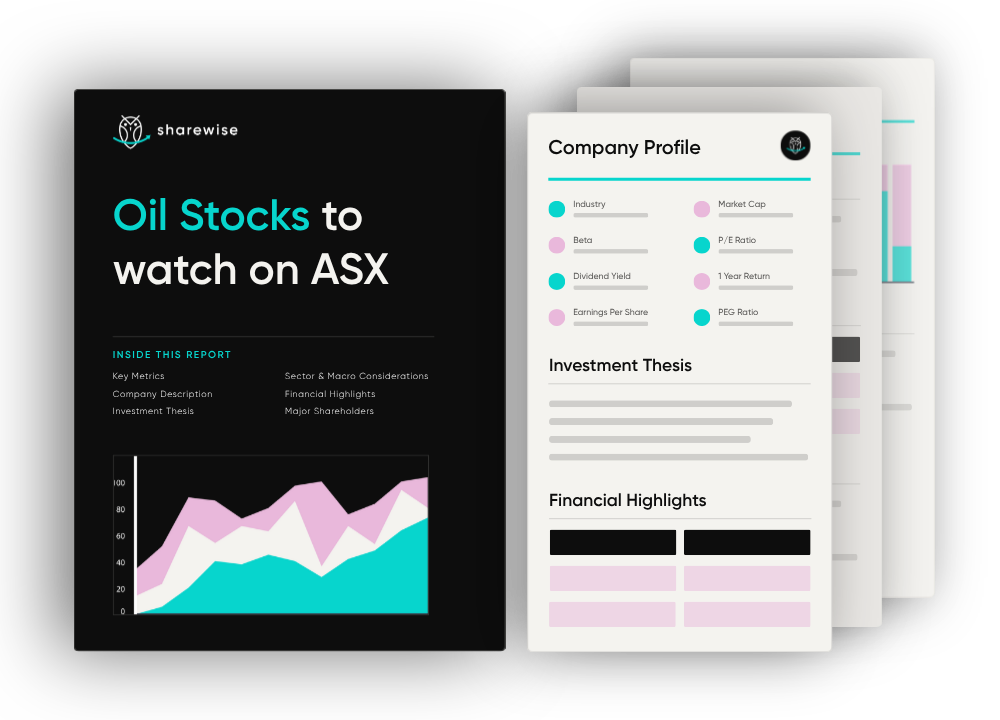
Each report contains an investment thesis from our research team, company-level production outlooks, and financial metrics including valuation ratios and balance sheet strength. We also include data on major institutional and insider shareholders.
Australian investors researching the energy sector, including SMSF trustees and self-directed investors. The report assumes some familiarity with company reporting but doesn't require specialist knowledge of the sector.
The report itself is updated monthly, so the companies and analysis reflect current conditions. Behind it, our core research and model portfolios are reviewed and updated regularly, with daily morning rundowns covering global market dynamics and weekly in-depth analyses reflecting production results, geopolitical shifts, and earnings from major producers.
Discover oil companies operating at the intersection of global energy security, the LNG "tsunami," and the ongoing transition to low-carbon efficiency.
Subscribe for updates for institutional research, webinars and events across ASX, US and global markets.
Full-service share advisory and stockbroking for Australian investors.
Level 9, 68 Alfred St S, Milsons Point NSW 2061
Sharewise Group Pty Ltd (ABN 22 664 471 247) is a Corporate Authorised Representative (No. 001302760) of Sharewise Compliance and Administration Pty Ltd (AFS License No. 280420).
The information provided by Sharewise is of a general nature only and does not take into account your personal financial situation, objectives, or needs. The information presented is for informational purposes only. Trading in stocks and other securities carries risks, including the potential loss of your invested capital. The market is subject to various factors that can impact the value and performance of securities. Some information on our website may be sourced from third parties believed to be reliable. While we make every effort to ensure accuracy, Sharewise cannot guarantee the completeness, accuracy, or timeliness of such information and assumes no responsibility for any errors or omissions. We do not guarantee the performance or returns on any investments or financial products mentioned, and past performance is not a guarantee of future results. Any investment decisions you make are your own responsibility, and you should consider seeking professional advice before making any financial decisions.
By submitting your details or downloading our material, you consent to Sharewise contacting you with related information.