Stock Spotlight: NVIDIA Corp (NASDAQ:NVDA)
About NVIDIA Corp
NVIDIA Corporation operates as a data center scale AI infrastructure company. The company operates through two segments, Compute & Networking, and Graphics segments. The Compute & Networking segment provides data center accelerated computing and networking platforms and artificial intelligence solutions and software, and automotive platforms and autonomous and electric vehicle solutions, including software. The Graphics segment offers GeForce GPUs for gaming and PCs; Quadro/NVIDIA RTX GPUs for enterprise workstation graphics. The company's products are used in gaming, professional visualization, data center, and automotive markets. The company sells its products to original equipment manufacturers, original device manufacturers, system integrators and distributors, independent software vendors, cloud service providers, add-in board manufacturers, distributors, automotive manufacturers and tier-1 automotive suppliers, and other ecosystem participants worldwide. It has a collaboration with Tech Mahindra Limited to develop artificial intelligence powered telco network operations reasoning agent. The company has a strategic partnership with Lumentum Holdings Inc. to develop optics technologies for AI and data centers. It also has a strategic partnership with Nebius Group N.V. to develop and deploy hyperscale cloud for the artificial intelligence market; and has a strategic partnership with IREN Limited to accelerate deployment of up to 5 gigawatts of infrastructure. NVIDIA Corporation was incorporated in 1993 and is headquartered in Santa Clara, California.
Source:EODHD
Key Stats
Key Stats
Source: EODHD Data as of 05/06/26.
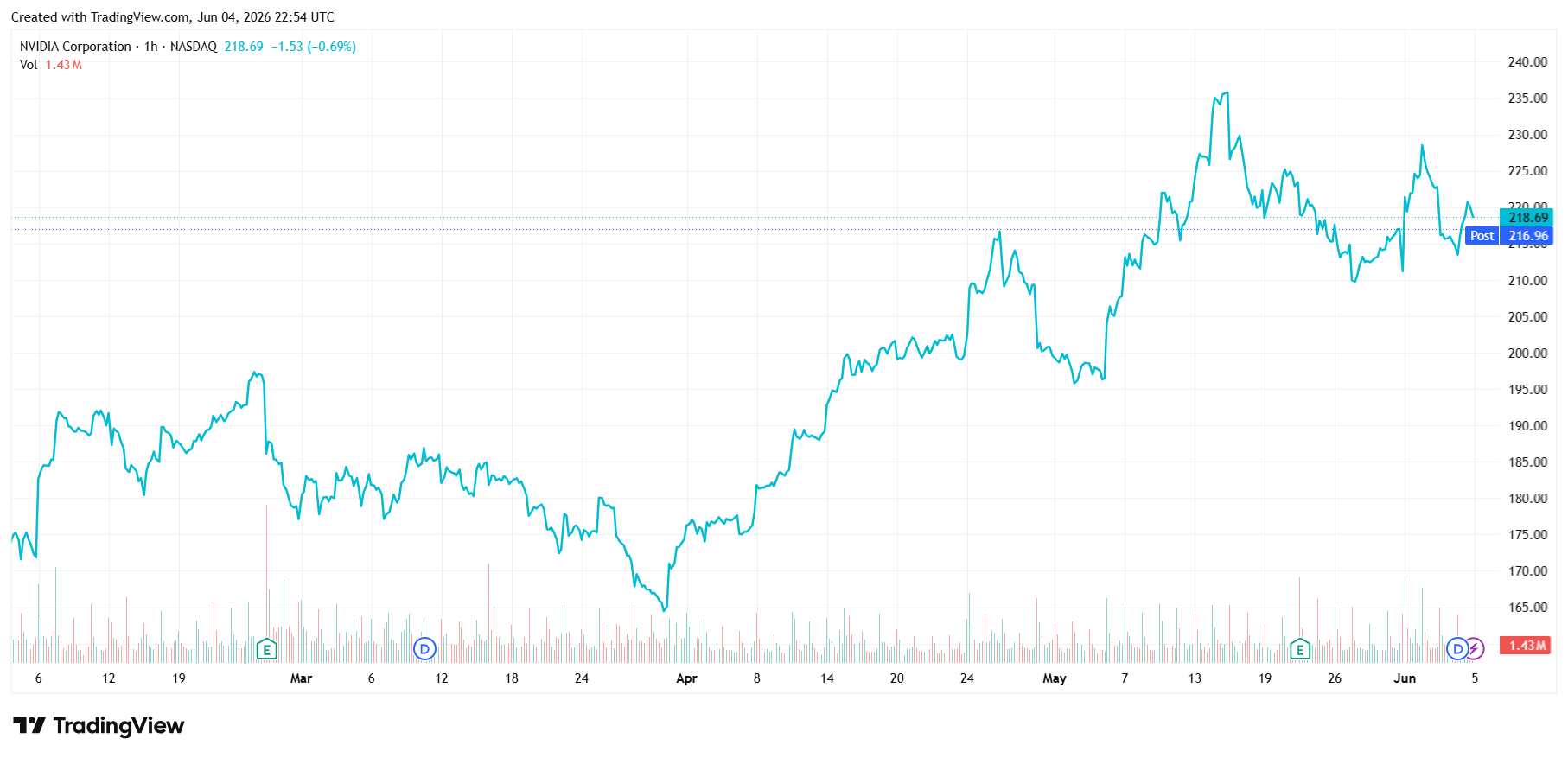
Price Performance
Growth Potential
- Dominance in AI computing (~80-90% market share in GPUs for AI training and inference) with the flagship H100, A100 and GH200 Grace Hopper GPUs are the backbone of hyperscaler/enterprise AI infrastructure and CUDA software ecosystem and optimized libraries creating a deep moat, making it difficult for customers to switch to competitors like AMD, Intel, or in-house chips.
- Explosive AI demand with generative AI, large language models and enterprise AI adoption driving unprecedented demand for high-performance compute leading to Hyperscalers (AWS, Microsoft Azure, Google Cloud, Oracle), AI labs (OpenAI, Anthropic, xAI) and governments scaling infrastructure aggressively. The company remains the arms dealer of the AI revolution, benefiting from every stage of AI growth (training, inference, deployment and edge computing).
- Expanding TAM with the company building end-to-end AI platforms including Networking (InfiniBand, Ethernet) via Mellanox, AI Cloud (DGX Cloud) delivered with hyperscalers, Omniverse & Digital Twins for industrial simulation and NVIDIA DRIVE for autonomous vehicles, with each initiative opening new multi-billion-dollar TAMs, reducing dependence on gaming cycles.
- Structural tailwinds with AI adoption still in its early innings across industries (healthcare, finance, manufacturing, defense) with CEO Jensen Huang believing the computational requirement for reasoning AI models is “easily” 100x more than previously thought, as more tokens must be generated and done so at a faster rate.
- High margin and strong FCF generation ensure solid shareholder returns.
Key Risks
- Customer concentration (~39% dependent on two hyperscalers) and spending cyclicality (hyperscalers overbuilding capacity or AI “capex digestion” phase).
- Increased competition from AMD, Intel, and custom AI chips (e.g., Google’s TPU, Amazon’s Trainium) could erode pricing power and margins.
- Geopolitical and regulatory scrutiny, especially regarding any export bans on advanced GPUs to China by the U.S.
- Supply chain risks as the company remains fabless and entirely relies on TSMC for manufacturing.
Subscribe to our newsletter
Disclaimer: This article does not constitute financial advice nor a recommendation to invest in the securities listed. The information presented is intended to be of a factual nature only. Past performance is not a reliable indicator of future performance. As always, do your own research and consider seeking financial, legal and taxation advice before investing.
Speak to an Advisor