Earnings Season Is Here: Why Your Portfolio Could Be More Volatile This Week
Why This Week Matters More Than Most
Every reporting season has defining moments. This week is one of them.
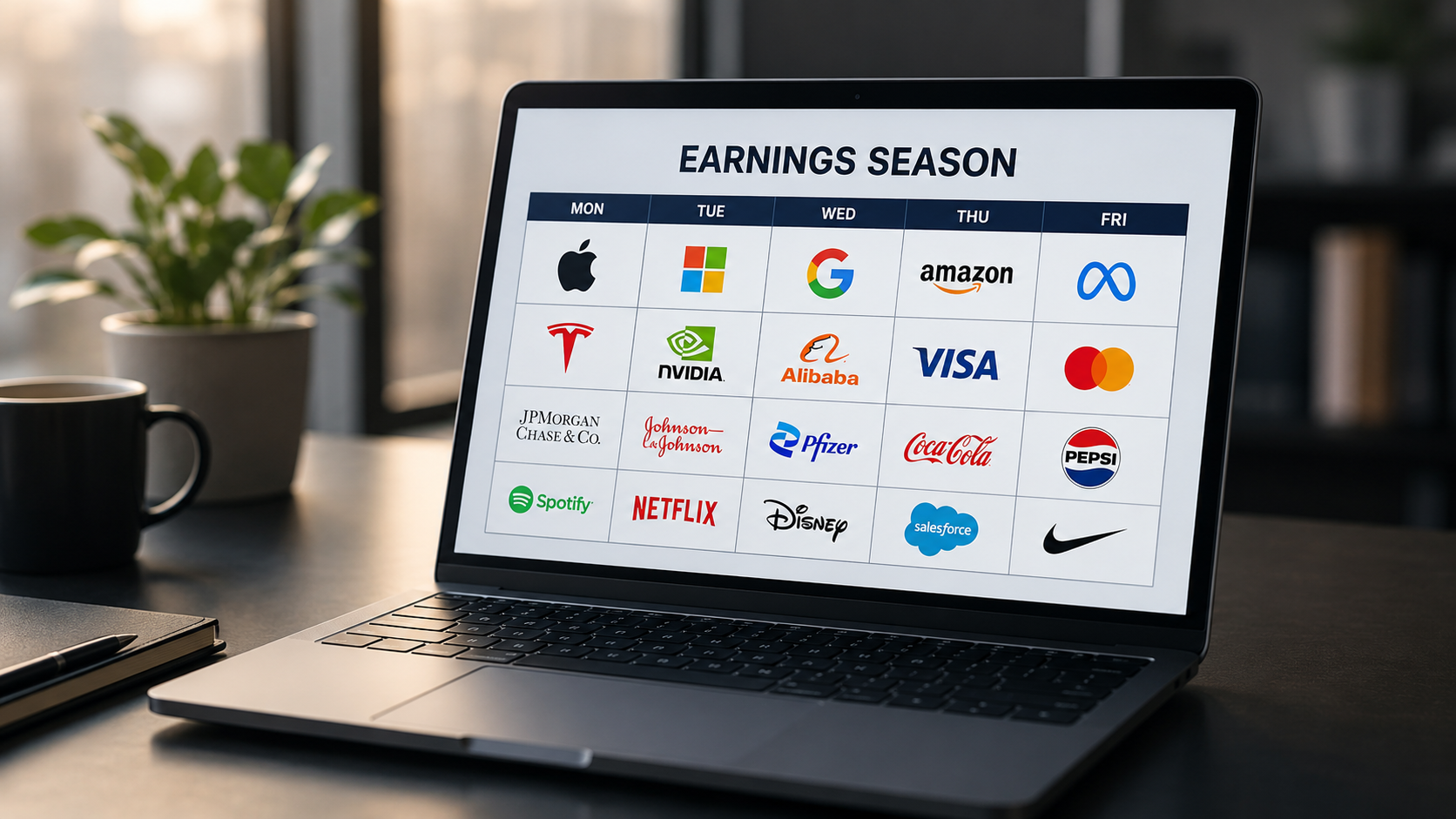
Within the same trading week, four of the world's largest listed companies, Microsoft and Meta Platforms on Wednesday (US time), followed by Apple and Amazon on Thursday, will release quarterly results. Collectively, these businesses sit at the centre of the dominant investment themes shaping global equity markets, including artificial intelligence (AI), enterprise technology spending, cloud computing, digital advertising and corporate capital expenditure.
Individually, each earnings report offers insight into a different segment of the economy. Together, they provide one of the clearest real-time assessments of whether the forces that have driven equity markets over the past two years remain intact. Their results will influence not only the valuation of individual companies, but also investor confidence in the broader growth narrative underpinning global markets.
The tone for the week was already established by Alphabet and Tesla, which both reported the previous week. Alphabet's result drew the most attention: while Google Cloud delivered another quarter of strong growth, market attention quickly shifted to a less encouraging development, free cash flow turned negative for the first time in the company's history as a publicly listed company, reflecting a sharp acceleration in AI infrastructure investment. Management also indicated that elevated capital expenditure is likely to continue over the coming quarters.
The tone for the week was already established by Alphabet and Tesla, which both reported the previous week. Alphabet's result drew the most attention: while Google Cloud delivered another quarter of strong growth, market attention quickly shifted to a less encouraging development, free cash flow turned negative for the first time in the company's history as a publicly listed company, reflecting a sharp acceleration in AI infrastructure investment. Management also indicated that elevated capital expenditure is likely to continue over the coming quarters.
That result has effectively set the benchmark for everything that follows.
The central question is no longer whether Microsoft, Meta, Apple or Amazon can marginally outperform consensus earnings estimates. Rather, investors are asking whether the market's defining growth themes, particularly AI investment, continue to justify the valuations attached to many of the world's largest companies. Increasingly, the focus is shifting from how much companies are spending to whether those investments are beginning to generate sustainable earnings growth, stronger cash generation and attractive long-term returns on capital.
At its core, this week's reporting calendar is less about individual earnings announcements than it is about testing the assumptions that have underpinned today's market leadership.
Why a Handful of Companies Can Move the Entire Market
One feature of markets in 2026 is unusually high concentration. A small number of companies now account for a disproportionate share of total index value. Microsoft, Apple, and Meta alone represent a substantial slice of both the S&P 500 and the Nasdaq 100, and when a stock of that size moves sharply on an earnings result, the effect isn't contained to that single company's shareholders.
This matters more than it might first appear, because of how much money now sits in passive, index-tracking investment vehicles. Trillions of dollars globally are invested through exchange-traded funds and index funds that hold these companies simply because they're large enough to be included in the benchmark. That means a significant earnings reaction in a mega-cap US technology stock is transmitted, often within the same trading session, into global equity funds, retirement accounts, and, relevantly for Australian investors, superannuation funds with international equity exposure.
The practical implication is one many retail investors overlook: you don't need to hold Microsoft or Meta directly for their earnings results to affect your portfolio's return. If your superannuation fund or a global equity fund you're invested in holds an index-tracking allocation to US shares, these results are already part of your exposure, whether you've thought about it that way or not.
Why Guidance Matters More Than the Headline Number
A common misconception is that earnings season is primarily about whether a company beats or misses analyst estimates for the quarter just gone. In practice, markets are forward-looking. Share prices already reflect a reasonable expectation of what a company is likely to report, built up from analyst forecasts in the weeks beforehand. What tends to move the share price on the day is not the historical result itself, but what it implies about the period ahead.
This produces outcomes that can look counterintuitive if you're only watching the headline number. A company can report record revenue and profit for the quarter and still see its share price fall, if management signals that growth is expected to slow, or that costs are rising faster than anticipated. Equally, a company can miss consensus estimates for the quarter just gone and still rally, if its guidance for the following quarter comes in stronger than the market expected.
This is exactly the dynamic already visible in Alphabet's result. The historical quarter looked solid. What moved the market was the capital expenditure signal and the free cash flow trajectory, both of which speak to the future, not the past. Investors watching Microsoft, Meta, Apple, and Amazon this week should expect the same pattern: revenue and earnings per share will set the initial reaction, but commentary on spending plans, margin outlook, and demand trends is likely to determine whether that reaction holds.
The Read-Through Effect: How One Result Ripples Across a Sector
Professional investors rarely analyse an earnings result in isolation. Instead, part of the analytical process involves assessing what that result implies for the company's suppliers, competitors and customers, a dynamic commonly referred to as the read-through effect.
Microsoft's results provide a clear illustration. Strong Azure cloud growth and continued investment in AI infrastructure have implications that extend well beyond Microsoft's own share price. They can influence sentiment towards semiconductor companies supplying the chips that power AI workloads, data centre REITs providing the underlying infrastructure, and even utilities supplying the significant electricity required to operate large-scale AI facilities. A strong or weak signal from Microsoft in these areas can reshape expectations across an entire supply chain, rather than affecting a single company in isolation.
Meta's results provide a different, but equally important, read-through. As one of the world's largest digital advertising businesses, its commentary on advertiser demand and consumer engagement can influence sentiment towards other companies exposed to the same advertising cycle, as well as the broader digital advertising and media sector.
It is important to be precise about what this mechanism does, and does not, indicate. The read-through effect describes how markets process new information, with one company's results influencing expectations across a related group of businesses, rather than predicting how any individual company will perform. It helps explain why sector-wide moves often follow a single earnings announcement, but it should not be interpreted as a signal that every company within that sector will move in the same direction.
What This Means for an ASX-Based Portfolio
For Australian investors, this week's cluster of US earnings is relevant in three distinct ways, each affecting portfolio performance through a different transmission channel.
The first is direct exposure through Australian-domiciled global equity funds, international managed funds and exchange-traded funds that hold these companies as part of a broader index or actively managed strategy. Many funds marketed as "global growth" or "international shares" maintain meaningful allocations to US mega-cap technology companies simply because of their size within global equity markets. Investors holding these funds therefore have exposure to this week's earnings, even if they have never intentionally invested in US technology stocks.
The second is indirect exposure through market sentiment rather than direct shareholdings. ASX-listed technology and growth companies frequently trade in sympathy with their US counterparts, reflecting the increasingly interconnected nature of global equity markets. Beyond individual stocks, a significant earnings surprise from a major US technology company can shift the broader risk-on or risk-off tone that influences the ASX 200 on the following trading day. This helps explain why the Australian market can open materially higher or lower despite little or no change in the domestic news flow, with overnight earnings driving sentiment before local investors have had an opportunity to respond.
The third is currency. For Australian investors with unhedged exposure to US assets, movements in the AUD/USD exchange rate can either amplify or offset the underlying investment return, depending on the direction of both the share price and the currency. As a result, the return earned in Australian dollars can differ meaningfully from the underlying US dollar performance, purely because exchange rates moved over the same period.
Why Short-Term Price Moves Don't Always Reflect Business Fundamentals
It is also worth understanding why earnings-day share price reactions are often considerably larger than the underlying change in a company's business. Moves of several percentage points in a single trading session are common following a major earnings announcement, even when the implications for the company's long-term earnings power are comparatively modest.
Several structural features of modern markets contribute to this. Automated and algorithmic trading strategies frequently react within seconds of an earnings release, long before investors have fully assessed the detail. Options positioning around reporting dates can further amplify price movements as hedging activity accelerates following the announcement. Index funds and ETFs may also need to rebalance in response to significant share price changes, while institutional investors reposition portfolios as earnings expectations evolve. Together, these factors can reinforce volatility independently of any meaningful change in the underlying business.
The point here is descriptive rather than predictive. Short-term price movements and long-term business fundamentals are not always conveying the same message, and recognising that distinction is important. A sharp move on the day of an earnings release reflects the market processing new information in real time, filtered through positioning, trading mechanics and investor sentiment. It should not automatically be interpreted as a definitive reassessment of a company's underlying value or long-term prospects.
What to Watch, and the Broader Takeaway
As reporting season continues, the focus will remain on a small set of recurring questions: whether AI investment is translating into revenue rather than just higher costs, whether margins can hold up under sustained capital spending, and what management commentary signals about broader demand across enterprise tech, advertising and consumers. Beneath the noise, the key point is that earnings season is less about verdicts and more about recalibration. Sharp share price moves rarely represent a simple “buy” or “sell” signal; they reflect the market rapidly updating expectations, repricing risk, and reassessing future growth.
For Australian investors, the same framework will apply when ASX reporting season begins on 12 August, led by Commonwealth Bank and followed by BHP. Despite sector differences, the process is identical: expectations versus outcomes, guidance over history, and what each result implies for the broader ecosystem of suppliers, competitors and demand. In both markets, the takeaway is the same: earnings season is not about final answers, but about how quickly and convincingly companies can reset the narrative.
Want to Talk Through What This Means For Your Own Portfolio?
Understanding these developments is one thing. Knowing what they mean for your own portfolio is another. If you're unsure how this reporting season may affect your investments, or whether your portfolio remains positioned for your long-term objectives, speak with a Sharewise adviser. We can help you interpret the latest market developments, assess the opportunities and risks, and ensure your investment strategy remains aligned with your financial goals.
Subscribe to our newsletter
Disclaimer: This article does not constitute financial advice nor a recommendation to invest in the securities listed. The information presented is intended to be of a factual nature only. Past performance is not a reliable indicator of future performance. As always, do your own research and consider seeking financial, legal and taxation advice before investing.
Speak to an Advisor