Investing in Hong Kong: Risks, Rewards & What Australian Investors Should Know in 2026
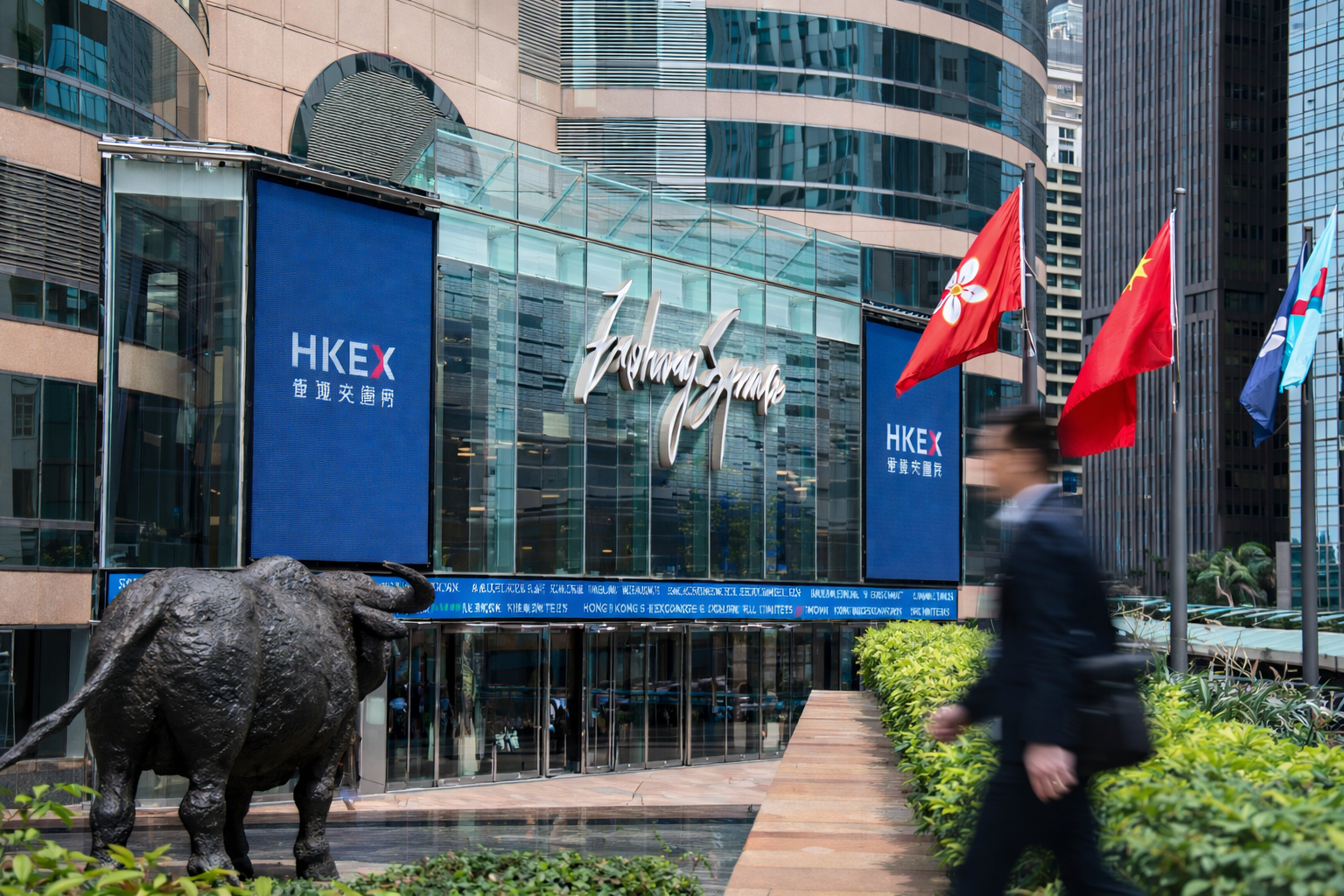

Hong Kong was written off by many just a few years ago, yet the Hang Seng Index surged around 28% in 2025, comfortably outpacing the S&P 500’s 16.3% gain. This dramatic rebound has put Hong Kong back in the spotlight as a leading destination for equity investors, attracting global attention with strong trading activity and a robust IPO pipeline.


For Australian investors, Hong Kong provides a unique combination of opportunities. It offers exposure to high-growth Chinese companies, thematic sectors such as technology and consumer services, and income-generating assets such as REITs, all within a well-established, internationally regulated market. Its proximity and aligned time zones make monitoring and trading more convenient, while its role as a gateway to mainland China gives access to companies and sectors underrepresented on the ASX. Adding Hong Kong equities enhances portfolio diversification, providing exposure to different economic cycles, industries, and regional growth dynamics.


With 2026 shaping up as another active year, understanding key trends, valuation opportunities, risks, and market access will be essential for Australian investors navigating opportunities ahead.


A Market Regaining Momentum


Hong Kong has long served as a bridge between China’s economy and international capital markets. As at the end of January 2026, total market capitalisation stood at HKD 50.8 trillion, up 44% year-on-year. More revealing is the surge in liquidity: average daily turnover in January 2026 reached HKD 227.3 billion, an 89% increase. ETF turnover averaged HKD 35.9 billion, while derivative warrants turnover rose 77%, and activity in callable bull/bear contracts doubled. These gains signal renewed engagement from both institutional and retail investors, supporting the credibility of valuation re-ratings.


Equity capital markets are likewise showing signs of revival. Thirteen companies listed in January 2026, a 63% increase year-on-year, raising HKD 39.3 billion via IPOs and HKD 53.1 billion in total funds. This reopening of the IPO market represents both a psychological and structural inflection point, reflecting growing investor confidence, improved liquidity, and renewed corporate willingness to raise capital.


The Rewards – Investment Opportunities


Valuations and Income Potential

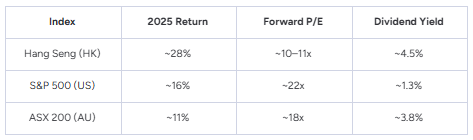
Hong Kong stocks remain genuinely inexpensive compared to US and Australian equities. The Hang Seng trades on a forward P/E of around 10–11x, less than half the S&P 500 (~22x) and below the ASX 200 (~18x). Dividend yields of approximately 4–5% add to the attractiveness for yield-focused Australian investors. HSBC Private Bank has set a Hang Seng target of 31,000 by end-2026, suggesting potential for both income and capital growth.

China Exposure via a Global Financial Hub

Hong Kong remains the primary offshore gateway to China. Its largest listed companies span Chinese banks, insurers, internet platforms, and consumer businesses. For Australian investors, this provides access to different economic drivers than the ASX 200, which is heavily bank- and resource-weighted. Exposure to Hong Kong introduces a different type of economic risk, tied to Asian consumer growth, technology innovation, and mainland financial services, offering genuine diversification benefits.

China’s accelerating commitment to AI adds another layer of opportunity. Government industrial policy prioritises semiconductors, foundries, and AI infrastructure, with private capital following suit. Australian investors who missed the US tech rally can access the AI and infrastructure build-out theme at lower valuation multiples, combining geographic diversification with structural growth exposure.


IPO and New Economy Exposure

The IPO pipeline remains a standout attraction. After leading global IPO fundraising in 2025, estimates for 2026 suggest total proceeds between HKD 320–350 billion. The reopening of capital markets reflects investor confidence, stronger liquidity, and corporate willingness to raise growth capital. Several large-cap and potentially global names are reportedly considering Hong Kong for primary listings, creating access to emerging leaders in technology, consumer goods, biotech, and AI. Participation in this IPO cycle offers exposure to companies shaping Asia’s economic growth at earlier stages than developed markets often allow.


Commercial Real Estate - Discounted Entry

For sophisticated investors, Hong Kong’s commercial property market presents potential opportunities. Recent market corrections have created entry points for patient capital, while mainland Chinese buyers remain active, reflecting confidence in long-term fundamentals. Hong Kong-listed REITs, such as Link REIT, provide a practical way to gain exposure to commercial property income streams without owning physical assets. These vehicles are accessible via most international brokerages and offer dividend income alongside capital appreciation potential.


The Risks - What to Watch

While the performance backdrop and structural drivers are compelling, Hong Kong investing is not without its risks.


Geopolitical Uncertainty

US–China strategic tensions remain an ongoing overhang for the region. Export controls, technology restrictions and broader trade frictions introduce policy unpredictability and can affect capital flows, particularly in sensitive sectors such as semiconductors and advanced technology. For investors, geopolitical risk justifies a persistent valuation discount, even during recovery phases. Any escalation in tensions could quickly weigh on sentiment and trigger renewed volatility.


Valuation Considerations

The rebound in Hong Kong markets has lifted valuations on several indices and individual stocks. In some segments, prices now sit above historical averages, particularly in tech and high‑growth segments. While not necessarily a warning of an imminent downturn, elevated valuations can compress future returns if growth expectations are not met or if external conditions sour.


Market Concentration

Despite broader participation, a relatively small number of large companies dominate trading volumes on the Hong Kong exchange. This concentration can make headline indices more sensitive to large‑cap performance swings, potentially obscuring market breadth or smaller‑cap opportunities.


Currency Considerations for Australians

The Hong Kong dollar is pegged to the US dollar, which means Australian investors are indirectly exposed to movements in the AUD/USD exchange rate. A stronger Australian dollar can dilute offshore returns when translated back into local currency, while a weaker dollar can enhance them. Currency exposure therefore forms part of the overall risk profile and can either amplify or offset underlying equity performance. Investors should consider whether to remain unhedged or seek hedged exposure depending on their broader portfolio positioning.


How Can Australians Actually Invest?


Australian investors have multiple avenues to gain exposure to Hong Kong’s markets, each with its own trade-offs in terms of diversification, risk, and access:


  • Direct HK-Listed Stocks: Full exposure to local pricing and dividends via brokers with HKEX access.
  • ETFs: Diversification across sectors and companies, including A+H share exposure.
  • Dual-Listed Companies: Access Hong Kong equities via ASX or US listings, avoiding direct FX conversion.
  • Managed Funds: Professional selection and currency management for a hands-off approach.
  • Structured Products / Derivatives: For sophisticated investors to hedge or leverage sector/market exposure.
  • REITs: Listed REITs provide access to commercial property income without physical ownership.


By choosing the right combination of instruments, Australians can align Hong Kong exposure with their risk appetite, income objectives, and thematic interests, from IPO participation and tech growth to commercial real estate and dividend income.


Final Thoughts: A Tactical Diversifier


Hong Kong offers a compelling blend of opportunity and nuance. Its gateway role to mainland China, combined with diverse sectors, IPOs, AI/tech exposure, and income-generating REITs, provides access to growth stories and cash flow streams largely absent from domestic markets. Valuations remain attractive relative to the US and Australia, particularly when factoring in dividend yields and potential for re-rating.


At the same time, investors should approach Hong Kong with discipline. Market concentration, geopolitical and regulatory uncertainties, and global macro sensitivity require careful allocation. Balancing direct equities, ETFs, dual-listed companies, and REITs can manage risk while capturing upside. Monitoring IPO activity, capital flows, and policy developments is essential.


Ultimately, Hong Kong should be considered a strategic complement to an Australian portfolio rather than a short-term trade. When approached with awareness of its structural characteristics and cyclical drivers, it offers both income and growth, enhancing diversification beyond domestic concentrations while participating selectively in high-potential sectors like technology, AI, and commercial real estate.


For strategic guidance on incorporating Hong Kong exposure into your portfolio, click here to speak to an adviser. Alternatively, click here to access our Hong Kong Stocks Report for free recommended stocks and market insights.


Subscribe to our newsletter

Disclaimer: This article does not constitute financial advice nor a recommendation to invest in the securities listed. The information presented is intended to be of a factual nature only. Past performance is not a reliable indicator of future performance. As always, do your own research and consider seeking financial, legal and taxation advice before investing.

Is a Share Advisor

right for you?

February 20, 2026
About Ferrari NV Ferrari N.V., through its subsidiaries, engages in design, engineering, production, and sale of luxury performance sports cars worldwide. The company offers sports, track, one-off, and road cars, as well as supercars. It also provides spare parts and engines, as well as after sales, repair, maintenance, and restoration services for cars; and licenses its Ferrari brand to various producers and retailers of luxury and lifestyle goods. In addition, the company operates Ferrari museums in Modena and Maranello; Il Cavallino restaurant in Maranello; and theme parks in Abu Dhabi and Spain. Further, it provides direct or indirect finance and leasing services; range of financial and ancillary services; special financing arrangements; and operates franchised and owned Ferrari stores. The company was founded in 1947 and is headquartered in Maranello, Italy. Source:EODHD Key Stats
February 20, 2026
In volatile markets, discipline matters most. Learn how dollar-cost averaging supports systematic capital deployment and reduces timing risk.
February 20, 2026
About Amazon.com Inc Amazon.com, Inc. engages in the retail sale of consumer products, advertising, and subscriptions service through online and physical stores in North America and internationally. The company operates through three segments: North America, International, and Amazon Web Services (AWS). It also manufactures and sells electronic devices, including Kindle, fire tablets, fire TVs, echo, ring, blink, and eero; and develops and produces media content. In addition, the company offers programs that enable sellers to sell their products in its stores; and programs that allow authors, independent publishers, musicians, filmmakers, Twitch streamers, skill and app developers, and others to publish and sell content. Further, it provides compute, storage, Artificial intelligence, database, analytics, machine learning, and other services, as well as advertising services through programs, such as sponsored ads, display, and video advertising. Additionally, the company offers Amazon Prime, a membership program. The company's products offered through its stores include merchandise and content purchased for resale and products offered by third-party sellers. It serves consumers, sellers, developers, enterprises, content creators, advertisers, and employees. The company was incorporated in 1994 and is headquartered in Seattle, Washington. Source:EODHD Key Stats
February 19, 2026
Understand how defensive investing can manage risk, generate stable income, and help you pursue consistent, long-term growth in uncertain markets.
February 18, 2026
Assess how Australia’s higher-for-longer rate environment impacts markets, assets, and portfolios, with insights on navigating risks and opportunities.
February 17, 2026
About Alphabet Inc Alphabet Inc. offers various products and platforms in the United States, Europe, the Middle East, Africa, the Asia-Pacific, Canada, and Latin America. It operates through Google Services, Google Cloud, and Other Bets segments. The Google Services segment provides products and services, including ads, Android, Chrome, devices, Gmail, Google Drive, Google Maps, Google Photos, Google Play, Search, and YouTube. It is also involved in the sale of apps and in-app purchases and digital content in Google Play and YouTube; and devices, as well as the provision of YouTube consumer subscription services, such as YouTube TV, YouTube Music and Premium, NFL Sunday Ticket, and Google One. The Google Cloud segment offers consumption-based fees and subscriptions for AI solutions, including AI infrastructure, Vertex AI platform, and Gemini enterprise. It also provides cybersecurity, and data and analytics services; Google Workspace that include cloud-based communication and collaboration tools for enterprises, such as Calendar, Gmail, Docs, Drive, and Meet; and other enterprise services. The Other Bets segment sells transportation and internet services. Alphabet Inc. was incorporated in 1998 and is headquartered in Mountain View, California. Source: EODHD Key Stats
February 17, 2026
Borrowing capital to invest remains the most effective tool available to sophisticated investors seeking to accelerate portfolio growth, yet it is often misunderstood as a "high-stakes gamble." Leverage amplifies your purchasing power, transforming a standard portfolio into a dynamic engine for wealth creation. While the concept of "risk-free" leverage is a mathematical impossibility, the ability to manage risk with institutional-grade precision is entirely achievable. Smart investors do not fear debt because they understand how to structure it as a calculated business strategy rather than a speculative bet. They respect the mechanics of gearing and employ professional oversight to mitigate the downside while capturing the upside of global markets. In 2026, the question isn't just about whether you should use leverage, but how you manage the journey from research to results. By moving away from "set-and-forget" retail habits and adopting an evidence-based framework, you can replace the anxiety of the unknown with the confidence of a professional strategy. How does margin lending work? Margin lending is a strategic tool that allows you to borrow capital to invest in approved shares, using your existing portfolio or cash as security. This creates a Loan-to-Value Ratio (LVR), which dictates your borrowing capacity against specific assets. While the lender holds security over the portfolio, the investor retains beneficial ownership and receives all dividends and franking credits. The mathematics of leverage are compelling when executed with professional-grade research and risk management. Consider a share-specific example: Initial Equity : You start with $100,000 in cash or existing blue-chip shares. The Leverage : You borrow an additional $100,000 to increase your total market exposure to $200,000. The Outcome : If the market rises by 10%, your total portfolio is now worth $220,000. The Professional Result : Instead of a $10,000 gain on your initial cash, you have achieved a $20,000 gain, representing a 20% return on your initial equity (before interest costs). When your portfolio value increases, the gains on the larger asset base belong entirely to you. Furthermore, for high-income earners, the interest on the loan is generally tax-deductible, making the effective cost of borrowing highly attractive. Why do investors fear the margin call? For many investors, the term "margin call" triggers a visceral reaction, often rooted in the "psychological scars" of past share market volatility, where unmanaged debt led to significant capital impairment. A margin call occurs when the market value of your shares falls below the lender's required LVR, forcing you to either contribute immediate cash or sell assets at depressed prices to restore the balance. This mechanism protects the lender but can devastate an unmanaged, "set-and-forget" portfolio. This fear typically stems from a lack of active, professional portfolio management. When you rely on a passive strategy while holding debt, you surrender control to market forces exactly when you need discipline and data-led execution the most. The Sharewise approach to mitigating risk: Proactive market monitoring : Our Chief Investment Officer looks at 5,000 stocks across all markets every day, ensuring we identify shifts before they become critical threats to your LVR. Data-driven discipline : We utilise technical and fundamental analysis to remove emotional "hope" from the equation, implementing strict protocols to protect your capital. Constant communication : Every investor has a dedicated advisor providing one-on-one communication, ensuring you are never left guessing during market corrections. Absolute transparency : Through our managed account structure, you can log in 24/7 to see exactly how your portfolio and leverage are performing, maintaining control with confidence. What is margin lending vs margin loan? Choosing the right debt structure for growth means moving beyond a basic comparison of loan types to understanding exactly how your facility is managed. While these terms are often used interchangeably in financial headlines, there is a strategic difference that every professional investor should recognise. Margin lending refers to the broader program or strategy of borrowing against securities to amplify your investment capacity. In contrast, a margin loan is the specific debt instrument or credit facility you use to execute that strategy. Understanding this distinction is vital for managing your LVR and maintaining absolute control over your financial future. Margin Lending (The Strategy): This is the overarching framework of borrowing to invest, technically known as "gearing". It requires institutional-grade research and constant vigilance to ensure your leverage supports growth without creating unmanaged risk. Margin Loan (The Product): This is the actual line of credit that carries the interest rate. When you are searching for the best margin lending rates, you are effectively comparing the cost of different margin loan facilities against the potential performance of your shares. By focusing on the margin lending strategy as a whole, rather than just the margin loan balance, you ensure your borrowing is supported by proactive market monitoring rather than just passive debt. Why margin lending outperforms generic debt When seeking to accelerate wealth, the choice of borrowing is just as critical as the choice of shares themselves. While many investors consider standard debt products, margin lending is specifically engineered for the equity market, offering a level of institutional-grade precision that generic borrowing cannot match. Choosing margin lending over other vessels of borrowing is a strategic decision for the serious investor. While personal loans or bank overdrafts can technically be used to buy shares, they are "blunt instruments" not designed for market dynamics. Risk Mitigation: Personal loans and overdrafts have no built-in LVR monitoring. Margin lending, when paired with professional portfolio management, includes daily oversight to ensure market dips don't become financial disasters. Tax Efficiency: In Australia, interest on a margin loan used to acquire income-producing shares is generally tax-deductible. While other loans can be deductible if used solely for investing, the administrative burden of "tracing" those funds is complex compared to a purpose-built margin lending facility. Cost of Capital: Because margin lending is secured against a liquid share portfolio, lenders often provide the best margin lending rates, whereas personal loans are unsecured and carry significantly higher interest costs that can eat into your investment performance. Cash Flow & Liquidity: An overdraft often requires rigid repayment schedules. Margin lending offers the flexibility to pay interest from dividends or capitalise it into the loan, allowing your share portfolio to compound more efficiently. Securing the best margin lending rates is only the first step; the real value lies in the active management of those funds. By moving away from "passive debt" and embracing a managed account structure, you transform a simple loan into a sophisticated utility for market outperformance. The path to risk-aware leverage While no investment is devoid of risk, the fundamental difference between reckless gambling and strategic gearing lies in the professional management framework. Securing the best margin lending rates is only the first step; the real value lies in the active management of those funds to ensure your share portfolio consistently outperforms the cost of debt. Professional advisors and investment managers utilise managed accounts to monitor LVR levels daily. This vigilance ensures that minor market dips are addressed before they become critical margin calls, providing professional portfolio management without losing control. The historical data supports a strategic approach; while Australian shares have delivered strong long-term averages, the real "profit margin" for the investor is the spread between the cost of debt and the potential return. Because interest on investment loans is generally tax-deductible for Australian residents, the real cost of holding a leveraged position is significantly lower than the headline rate. Risk aware leverage involves three core pillars: Conservative LVRs: Never borrowing to the maximum limit allows a buffer for market volatility. Diversification : Spreading capital across unconnected sectors reduces the likelihood of the entire portfolio dropping simultaneously. Active Management: Using a professional service to rebalance the portfolio proactively rather than reactively. To truly understand how professional management protects your capital, compare the Sharewise institutional approach against the typical retail experience:
February 17, 2026
For the high net worth Australian investor, "safety" is often a mislabeled form of concentration. While many high-net-worth individuals have successfully accumulated wealth, their portfolios frequently remain anchored to the familiar: residential property and the "Big Four" banks. This creates a structural imbalance where investment performance is inextricably tied to a single, resource-heavy economy and the local interest rate cycle. Achieving true diversification requires accepting a stark reality. The Australian Securities Exchange represents less than 2% of the global equity market. To ignore the remaining 98% is a strategic decision to cap potential returns while doubling down on local risks. Real wealth preservation demands an agnostic strategy that prioritises data over geography.  However, the modern professional is often time-poor, possessing the capital for growth but lacking the hours required to analyse complex, global datasets. In this article, we examine how high-net-worth investors can construct resilient, performance-led asset allocations through global equities and alternative investments, the difference between genuine diversification and hidden concentration risk, and how the Sharewise methodology is designed to compound wealth beyond the ASX by applying institutional-grade discipline to private portfolios.
February 17, 2026
About CAR Group Limited.  CAR Group Limited engages in the online vehicle marketplace business in Australia, New Zealand, Brazil, South Korea, Malaysia, Indonesia, Thailand, Chile, China, and North America. The company operates through six segments: Australia " Online Advertising Services; Australia " Data, Research and Services; Investments; North America; Latin America; and Asia segments. It offers classified advertising that allows private and dealer customers to advertise automotive and non-automotive goods and services for sale across the carsales network; products, including subscriptions, lead fees, listing fees, and priority placement services; and display advertising services, such as placing advertisements for corporate customers comprising automotive manufacturers and finance companies. The company also provides software as a service, research and reporting, valuation, appraisals, and website development and hosting services, as well as photography services. In addition, it offers vehicle inspection services; operates digital automotive and non-automotive marketplaces; and offers automotive data and advertising services. The company was formerly known as carsales.com Ltd and changed its name to CAR Group Limited in November 2023. CAR Group Limited was incorporated in 1996 and is headquartered in Melbourne, Australia. Source: EODHD Key Stats
February 17, 2026
About Northern Star Resources Ltd. Northern Star Resources Limited engages in the exploration, development, mining, and processing of gold deposits. The company also sells refined gold. It operates in Western Australia, the Northern Territory, and Alaska. Northern Star Resources Limited was incorporated in 2000 and is headquartered in Subiaco, Australia. Source:EODHD Key Stats