The Jensen Huang Risk: What His Departure Means for NVIDIA and the Future of AI
When the Face of the AI Revolution Steps Away
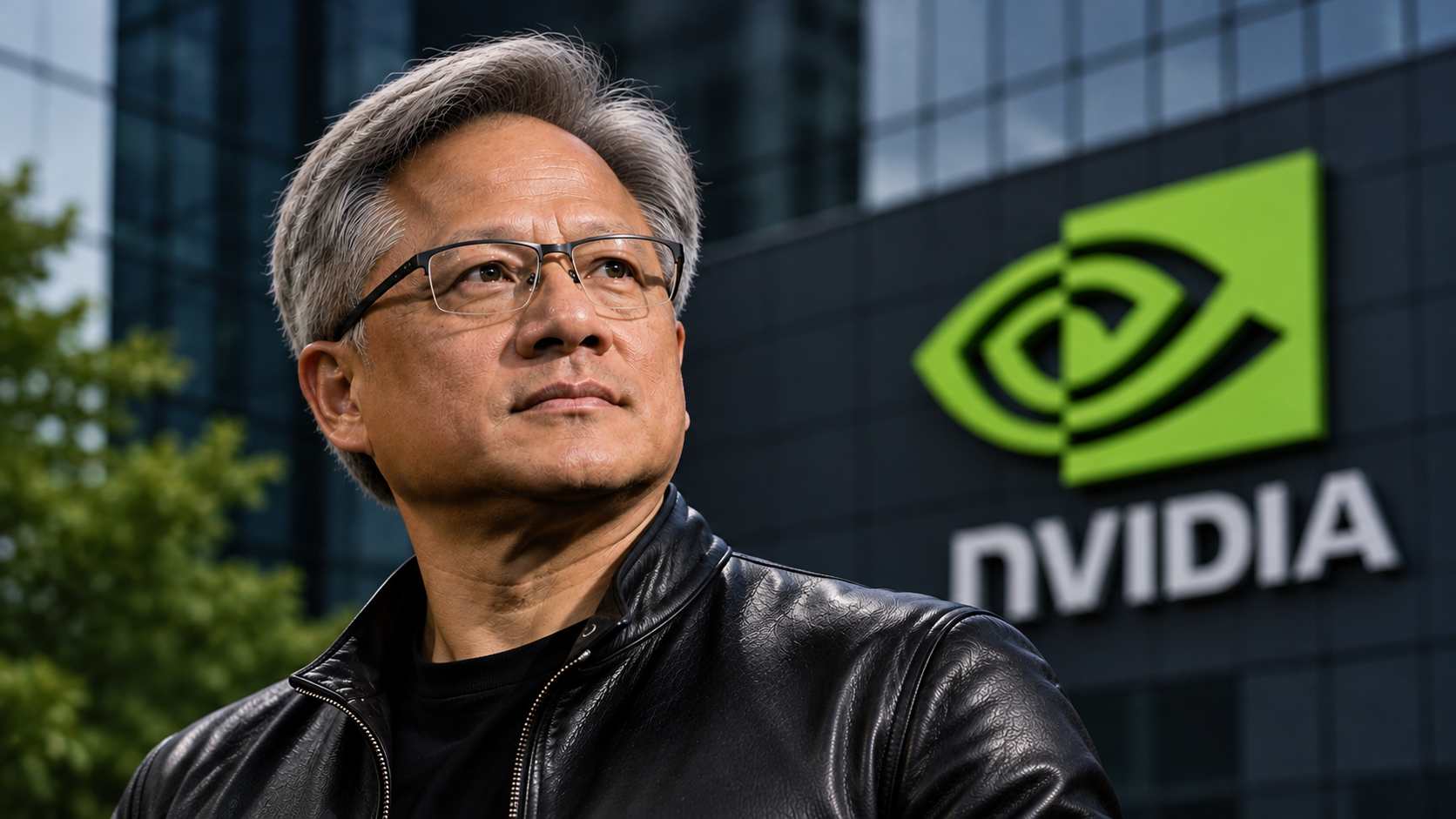
For more than three decades, Jensen Huang's leadership has been closely tied to NVIDIA's (NASDAQ: NVDA) evolution. Since co-founding the semiconductor company in 1993, he has overseen its transformation from a graphics chip manufacturer into a leading supplier of AI computing infrastructure, with its processors powering major data centres and advanced AI models.
That era came to an abrupt end on 12 November 2026, when NVIDIA announced that Huang had resigned as President and Chief Executive Officer, effective immediately, bringing his 33-year tenure to a close. The departure follows mounting scrutiny over his personal relationships, allegations involving a suspected Chinese intelligence operative and questions about corporate governance. Chief Financial Officer Colette Kress has been appointed interim CEO while the board searches for a permanent successor.
Huang's influence extended beyond product development to shaping NVIDIA's strategic direction and building relationships with technology executives, policymakers and investors. For investors, his departure raises a central question: are NVIDIA's competitive advantages sufficiently embedded within its technology, software and business ecosystem to withstand the loss of its founder?
How It Unfolded
The sequence of events moved quickly. On 8 November, NVIDIA's board announced an independent investigation into Huang's conduct, overseen by a committee of independent directors and supported by external legal counsel. Huang subsequently emailed employees, apologising and taking responsibility while pledging to cooperate fully with the investigation. On 10 November, the independent directors retained Joon H. Kim, a former acting US attorney for the Southern District of New York, and his firm, Wachtell, Lipton, Rosen & Katz, to conduct the review.
The situation escalated following further reports about Huang's personal conduct, including allegations of a relationship with a senior NVIDIA employee. According to Reuters, the board subsequently considered his future as chief executive.
On 12 November, NVIDIA announced that Huang had resigned as president, CEO and a member of the board, effective immediately. Kress was appointed interim CEO while retaining her finance responsibilities. The company also appointed longtime director Harvey C. Jones, a former CEO and executive chairman of Synopsys, as its first board chair, establishing a new leadership position.
The board has commenced a search for a permanent CEO, considering both internal and external candidates. NVIDIA has sought to reassure stakeholders that its operations, customer commitments and technology roadmap will continue without interruption.
The Market Reaction
Market concerns emerged ahead of the formal announcement, with at least six analysts downgrading NVIDIA between Wednesday evening and Thursday morning. Following confirmation of Huang's resignation, the shares fell as much as 14.3% shortly after the market opened before recovering some losses to close more than 4% lower. This left NVIDIA with a market capitalisation slightly above USD 4 trillion. The decline adds to a broader pullback, with the stock down approximately 32% from its early October peak, representing more than USD 1.8 trillion in lost market value.
The sell-off extended beyond NVIDIA. Taiwan Semiconductor Manufacturing Company (NYSE: TSM), its key manufacturing partner, fell 2.3%, while Chinese technology companies Alibaba and Tencent declined 6.8% and 2.6%, respectively. Shares of other companies backed by NVIDIA also came under pressure, reflecting the extent of its commercial and strategic relationships across the AI ecosystem.
NVIDIA's substantial weighting in major equity indices creates a further source of market exposure. Representing more than 6% of the S&P 500, its share-price movements can materially influence broader index performance. This also affects investors holding US and global index funds, including Australian investors, who may have significant indirect exposure to NVIDIA without owning its shares directly. The episode highlights how leadership and governance risks at a single mega-cap company can extend well beyond its shareholder base.
The China Allegations: Where Governance Meets National Security
At the centre of the controversy is Alice Huang, a Chinese businesswoman formerly associated with Singapore-based data centre operator Megaspeed International. US intelligence officials reportedly suspect her of links to China's Ministry of State Security and potentially using her personal relationship with Jensen Huang to obtain information. The two are not related. The allegations have attracted attention because Megaspeed reportedly purchased billions of dollars' worth of NVIDIA chips, with US authorities examining whether advanced processors were diverted through third countries to Chinese customers in breach of export restrictions.
US President Donald Trump has confirmed that the FBI is investigating the alleged personal and business connections. Beijing has rejected the espionage allegations, while Singaporean authorities have stated that their earlier investigation into Megaspeed concerned suspected false declarations involving server shipments, rather than espionage. These remain allegations, not established findings of wrongdoing.
NVIDIA has maintained that Huang's interactions with Alice Huang were not unusual and that its board has no reason to believe national security or company secrets were compromised. There is no confirmed public evidence that Huang knowingly assisted Chinese intelligence or that proprietary technology was transferred to Beijing. The controversy has also prompted shareholder litigation, with a proposed class action alleging that Huang failed to disclose the relationship and misled investors about the associated risks. The allegations have not been proven.
For shareholders, the implications extend beyond Huang's personal conduct to NVIDIA's corporate governance, export compliance and oversight of third-party customers. Scrutiny of Megaspeed's activities could intensify questions about the company's ability to monitor the distribution and end use of its advanced chips. Demonstrating that its internal controls can adequately manage these risks will be important to maintaining confidence among investors, regulators and government customers.
Caught Between Washington and Beijing
The controversy has intensified scrutiny of NVIDIA's position in the US-China technology rivalry, particularly Huang's longstanding opposition to restrictions on advanced semiconductor exports. Huang has argued that limiting China's access to American AI chips could accelerate the development of domestic alternatives, potentially weakening US technological leadership over time. NVIDIA has also maintained that it complies with applicable export regulations.
The allegations surrounding Megaspeed could add momentum to three proposed US legislative measures being considered as part of the fiscal 2027 National Defense Authorization Act (NDAA). The AI Overwatch Act would strengthen congressional oversight of advanced chip exports, the Chip Security Act would introduce additional tracking requirements to combat semiconductor smuggling, while the MATCH Act would encourage US allies to tighten restrictions on semiconductor manufacturing equipment supplied to China. All three proposals have advanced through the House Foreign Affairs Committee and are under consideration in the Senate's defence authorisation process. Their eventual passage and final provisions remain uncertain.
For NVIDIA, tighter export controls could increase compliance costs, complicate international distribution and further constrain access to China, a strategically important market despite existing restrictions on the products it can sell there. The broader challenge is balancing commercial opportunities with national security obligations. As AI infrastructure becomes increasingly important to economic and strategic interests, geopolitical policy could play a greater role in determining which markets NVIDIA can serve and how its technology is distributed.
Is NVIDIA's Moat Bigger Than Its Founder?
Huang's influence on NVIDIA was extensive. Beyond overseeing product development and corporate strategy, he became the public face of the AI revolution, maintaining relationships with major cloud providers, semiconductor manufacturers and government officials. His technical vision helped position NVIDIA ahead of the rapid expansion in AI computing demand.
However, NVIDIA's competitive advantages extend beyond one individual. Its GPU architecture and CUDA software platform form the foundation of an integrated computing ecosystem used by developers, researchers and enterprises. CUDA enables software to run efficiently on NVIDIA hardware, creating switching costs for customers whose applications and infrastructure have been developed around the platform.
The company's networking technologies, systems integration and established developer community further strengthen its position. These capabilities have developed over many years and are supported by engineering teams, intellectual property and commercial relationships that remain in place despite the leadership change.
Maintaining these advantages will require continued execution. NVIDIA faces competition from AMD, which is expanding its AI accelerator portfolio, and Broadcom, which supplies custom AI chips and networking technology to major technology companies. Large cloud providers are also developing proprietary processors to reduce their reliance on external suppliers. These competitive pressures predate Huang's resignation and do not necessarily mean rivals will benefit from his departure.
The wider AI investment cycle also creates exposure beyond NVIDIA's direct operations. Its customers are committing substantial capital to data centres, computing infrastructure and networking equipment, while the company maintains extensive commercial and strategic relationships across the AI supply chain. This interconnected structure supports demand for NVIDIA's products but also increases exposure to changes in hyperscaler spending, infrastructure financing and AI adoption. A leadership transition does not necessarily weaken these demand drivers, although prolonged uncertainty could affect customer relationships and strategic execution.
What to Watch From Here
The first major test comes next week, with NVIDIA's third-quarter fiscal 2027 results scheduled for 17 November (US time). The results will mark Kress's first public appearance as interim CEO, with investors likely to focus on her commentary on China, export restrictions, data centre demand and the company's operational outlook.
Beyond the results, several developments will shape NVIDIA's outlook:
- Permanent CEO appointment: Whether the board favours an internal successor or an external candidate, and how the transition affects strategic continuity.
- Independent investigation: The findings will determine whether the governance concerns are contained or lead to further scrutiny.
- US export legislation: Progress of the defence authorisation bill, particularly provisions affecting advanced chip exports and semiconductor supply chains.
- Congressional testimony: Huang has agreed to testify before Congress following his resignation, potentially bringing further attention to the allegations and NVIDIA's relationship with China.
NVIDIA's position was built over decades of semiconductor engineering, software development and ecosystem investment. These competitive advantages do not disappear with a change in leadership. However, the coming months will test whether they are sufficiently embedded within the organisation to withstand the departure of their founder. That challenge comes as Washington reassesses the conditions under which NVIDIA's most advanced technology can reach international markets, adding further uncertainty to the company's next phase of growth.
Subscribe to our newsletter
Disclaimer: This article does not constitute financial advice nor a recommendation to invest in the securities listed. The information presented is intended to be of a factual nature only. Past performance is not a reliable indicator of future performance. As always, do your own research and consider seeking financial, legal and taxation advice before investing.
Speak to an Advisor