The Rearmament Trade: Why Defence Equities Keep Climbing

Defence Has Shifted From Cyclical Trade to Structural Theme
For much of the post-Cold War era, defence investing was viewed as cyclical in nature, with geopolitical flare-ups periodically driving short-term sector outperformance before tensions eventually eased. That dynamic has shifted materially. Institutional investors now view defence as a long-duration capital allocation theme supported by sustained government spending, evolving security priorities and rapid technological change.
The sector’s recent market performance reflects this transition. Defence equities across Europe, the United States and parts of Asia-Pacific have significantly outperformed broader indices over recent years as investors reassessed the durability of military expenditure growth. Global defence spending has risen almost 30% over the past three years, representing the fastest increase since the 1980s.
The investment case is no longer tied solely to active conflicts. Markets are now pricing in a prolonged period of geopolitical fragmentation, strategic competition and sovereign security prioritisation. In many respects, defence has moved from a reactive trade to a strategic allocation theme.
The End of the “Peace Dividend” Era
Russia’s invasion of Ukraine in early 2022 marked a major turning point for global defence policy. For decades after the Cold War, much of Europe operated on the assumption that large-scale conventional conflict on the continent was unlikely. Defence spending was gradually reduced, procurement slowed and military readiness became less of a political priority.
That changed rapidly after Ukraine. Governments were forced to confront how years of underinvestment had weakened military capability and exposed supply chain vulnerabilities. Germany’s EUR100 billion special defence fund became one of the clearest examples of the shift, while NATO members accelerated efforts toward higher defence spending targets that had previously been treated as aspirational.
The shift is no longer confined to Europe. Across the Indo-Pacific, rising strategic competition between the United States and China, maritime security concerns and ongoing Taiwan tensions have prompted regional governments to accelerate military modernisation programs and deepen defence partnerships.
The scale of the transition has expanded further. NATO now aims for members to allocate 5% of GDP toward defence and broader security spending by 2035, well above the alliance’s earlier 2% benchmark. With alliance members currently spending around EUR1.4 trillion annually on defence, reaching the revised target would require more than EUR1 trillion in additional yearly expenditure. Renewed instability in the Middle East during 2026 reinforced the urgency behind those commitments.
These are no longer long-term policy discussions. Procurement programs, weapons replenishment and military modernisation plans are already underway, supporting what now appears to be a sustained uplift in global defence spending rather than a temporary geopolitical response.
Defence Spending Is Expanding Beyond Europe
The current rearmament cycle is no longer confined to Europe. Across the Indo-Pacific, rising strategic competition between the United States and China, maritime security concerns and ongoing Taiwan tensions are driving a broader acceleration in military spending and defence modernisation.
Australia has emerged as one of the clearest regional examples of this shift. In April 2026, Canberra announced plans to increase defence spending to 3% of GDP by 2033, reflecting a more aggressive posture toward national security and regional deterrence. The package includes an additional AUD14 billion over four years and AUD53 billion over the coming decade, with funding directed toward missiles, drones, naval capability, autonomous systems and broader military infrastructure upgrades. Programs linked to AUKUS and long-range strike capability are also expected to support sustained defence investment over the medium term.
The trend extends well beyond Australia. Governments across Asia-Pacific are prioritising sovereign capability, supply chain resilience and military preparedness as geopolitical uncertainty intensifies. This is contributing to a longer-duration defence spending cycle that resembles a broader strategic reset rather than a temporary response to isolated conflicts.
For investors, the significance lies in the duration and visibility of these expenditure programs. Defence procurement cycles often extend across multiple years, supporting strong order backlogs and recurring revenue visibility for contractors exposed to aerospace, naval systems, cybersecurity, surveillance and advanced defence technologies.
Modern Warfare Is Driving a Technology Upgrade Cycle
Recent conflicts have changed not only how much governments are spending on defence, but also what they are buying. The wars in Ukraine and the Middle East demonstrated that drones have become a decisive battlefield technology, used for reconnaissance, precision strikes and sustained logistical disruption in ways that traditional air-defence systems were never designed to counter.
Governments have responded with accelerated procurement activity across counter-drone capability, AI-enabled targeting systems, autonomous platforms, cybersecurity and missile defence. The defence sector is becoming more closely tied to software, advanced electronics and artificial intelligence rather than traditional heavy manufacturing alone.
Australian-listed DroneShield illustrates the scale of this transition. The company grew revenue from approximately AUD5 million in 2020 to roughly AUD227 million in 2025 as military demand for counter-drone systems expanded sharply, particularly in the United States. Its positioning in drone detection and neutralisation systems, combined with a software subscription model supporting continuous AI-driven updates, has strengthened recurring revenue visibility alongside hardware sales.
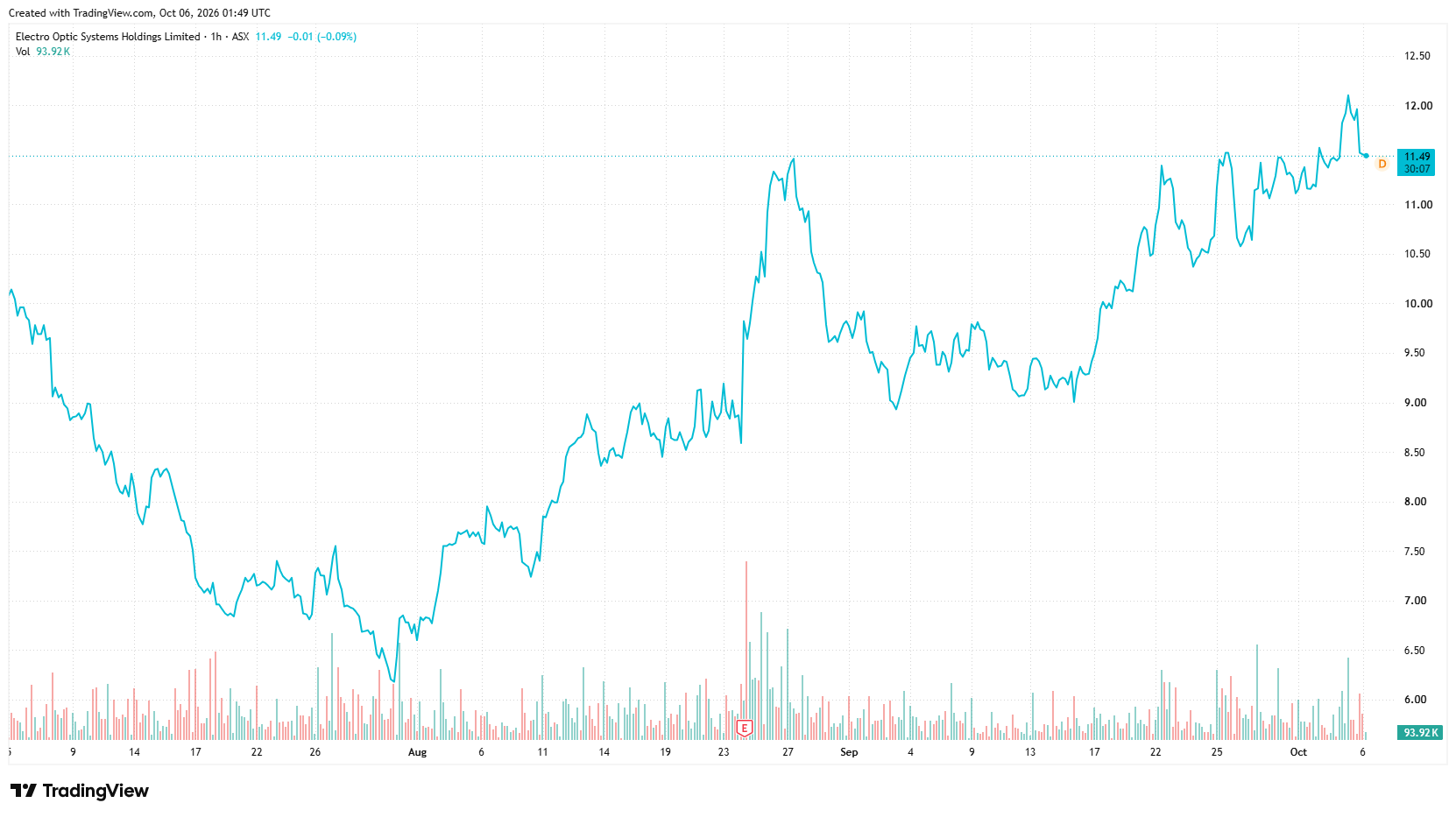
Directed energy systems are also emerging as a major investment category. Electro Optic Systems has secured high-energy laser contracts with European and South Korean customers valued at more than AUD240 million combined, reflecting growing interest in lower-cost alternatives to traditional missile-based interception systems.
The procurement cycle is now being reinforced by real-time battlefield adaptation. Active conflicts are generating operational data that shapes future capability requirements, while governments are compressing the time between identifying operational needs and awarding procurement contracts. For investors, this is expanding the defence opportunity set beyond traditional prime contractors into software, AI, cybersecurity and advanced sensor technologies.
Why Investors Continue to Favour Defence Stocks
The appeal of defence equities rests on something relatively rare in equity markets: government-backed revenues with long-dated visibility. Unlike consumer-facing sectors, defence spending is driven more by strategic policy priorities than short-term economic cycles, supporting stable demand profiles and multi-year procurement pipelines.
That dynamic has been reflected in sector performance since early 2022. European defence names including Rheinmetall, Leonardo and BAE Systems have strongly outperformed broader markets as investors repriced the sector around structurally higher defence spending expectations. The trend has extended to Australia, where defence-linked companies have also benefited from rising procurement activity and renewed investor attention.
Among ASX-listed names, DroneShield offers the strongest growth exposure, entering FY2026 with approximately AUD154.8 million in committed revenue and a reported AUD2.2 billion sales pipeline. The company recently achieved statutory profitability, supported by growing demand for counter-drone systems and recurring software revenue linked to its AI-enabled platforms.
Electro Optic Systems provides exposure to directed energy systems and remote weapons technology. Its order backlog expanded to approximately AUD459 million from AUD136 million at the end of 2024, with management targeting conversion of roughly 40% to 50% of that backlog into 2026 revenue, implying approximately AUD180 million to AUD230 million in potential revenue. The uplift in contracted work reflects growing demand for next-generation defence capability across Europe, South Korea and Australia, while supporting expectations that the business could move closer toward operating break-even as recent contract wins convert into revenue.
Austal offers the most established earnings profile of the three. Its order book, including options, has reached approximately AUD17.7 billion, underpinned by long-duration naval programs extending into the late 2030s. Although FY2026 EBIT guidance was revised lower following issues tied to the US Navy T-ATS program, the scale of its backlog continues to provide substantial long-term revenue visibility.
More broadly, investor sentiment toward the sector has improved as defence spending appears increasingly structural rather than cyclical. Combined with rising procurement budgets, expanding order books and growing geopolitical uncertainty, this has driven a substantial re-rating across global defence equities.
Risks, Valuation Pressures and Execution Challenges
Despite the sector’s strong momentum, investors should remain mindful of several key risks. Valuations across many defence names have expanded materially following significant share price appreciation over recent years, with some companies now priced for sustained execution success and continued procurement growth.
DroneShield, for example, continues trading on elevated revenue multiples following its rapid growth trajectory, supported by approximately AUD154.8 million in committed FY2026 revenue and a reported AUD2.2 billion sales pipeline. While operational momentum remains strong, the company is still reliant on securing large defence contracts in a highly competitive and rapidly evolving counter-drone market.
Execution risk also remains important across the sector. Electro Optic Systems has demonstrated significant backlog growth, with its order book increasing to approximately AUD459 million from AUD136 million at the end of 2024. Management expects roughly 40% to 50% of that backlog to convert into 2026 revenue, implying approximately AUD180 million to AUD230 million in potential revenue generation. However, the company still faces pressure to convert growing order flow into sustainable profitability after recent earnings volatility tied to project timing and restructuring activity.
Austal highlights the operational complexity attached to large-scale defence programs. Although the company maintains a substantial AUD17.7 billion order book extending into the late 2030s, recent revisions to FY2026 EBIT guidance from AUD135 million to AUD110 million following issues tied to the US Navy T-ATS program reinforced how execution, cost control and contract management can materially affect earnings outcomes even within long-duration procurement cycles.
At the same time, rapid technological evolution introduces additional competitive disruption risk. The increasing role of AI, autonomous systems, electronic warfare and directed energy technologies may shorten technology lifecycles and accelerate obsolescence across certain defence platforms. Political and fiscal risks also remain relevant. While the current geopolitical environment supports elevated defence spending, procurement priorities can still shift over time depending on government budgets, election cycles and broader diplomatic developments.
The Rearmament Cycle May Still Be Early
Despite the significant re-rating already recorded across global defence equities, the structural case for continued defence expenditure growth appears intact. The forces driving rearmament, including geopolitical fragmentation, energy security concerns, great power competition and sovereign resilience priorities, resemble long-duration structural shifts rather than short-term geopolitical disruptions. Governments are now committing to multi-year procurement programs spanning military capability, cybersecurity, critical infrastructure and domestic industrial capacity.
The sector is evolving from a tactical geopolitical trade into a broader strategic investment theme. After the sharp share price appreciation seen across many defence names, the next phase of performance will likely depend more heavily on execution and earnings delivery rather than thematic momentum alone.
The near-term focus across the sector is shifting toward backlog conversion, procurement execution and margin sustainability as companies attempt to translate strong order growth into durable profitability. Defence contractors benefiting from rising procurement activity still face operational, competitive and technological pressures, particularly as governments accelerate procurement timelines and defence technology cycles continue shortening.
The structural demand supporting the sector is increasingly clear. The more important question for investors now is whether defence companies can convert expanding order books into sustainable earnings growth while justifying the premium valuations the market has already assigned to what may still be a relatively early-stage rearmament cycle.
Not Sure Where to Start With Defence Stocks?
Understanding valuation, procurement cycles and execution risk remains critical as the sector evolves. If you would like to discuss defence-related investment opportunities or how the global rearmament trend may fit within your portfolio strategy, speak with an adviser today.
Subscribe to our newsletter
Disclaimer: This article does not constitute financial advice nor a recommendation to invest in the securities listed. The information presented is intended to be of a factual nature only. Past performance is not a reliable indicator of future performance. As always, do your own research and consider seeking financial, legal and taxation advice before investing.
Speak to an Advisor