Stock Spotlight: Fortescue Ltd (ASX:FMG)

Fortescue Ltd (ASX: FMG), more commonly known as Fortescue Metals Group, is one of Australia's largest miners, famous worldwide for its iron ore. Andrew Forrest founded the Perth-based company in 2003, and since that time, it's evolved from a challenger brand into a multi-billion-dollar powerhouse that competes with the producers on the world stage.


Fortescue isn't just about resource strength anymore. It's charting a bold, new path away from iron ore towards a greener energy future. To make smart portfolio decisions, you've got to understand where FMG is now and where it’s heading next.


At Sharewise, our expert insights and data-driven stock reports help self-directed investors, SMSF trustees, and long-term market participants evaluate opportunities such as FMG with confidence.


About Fortescue Ltd


Fortescue Ltd started in 2003 and quickly became one of the world’s largest iron ore producers. The company is based in Perth and operates significant mining projects across the Pilbara region of Western Australia (Chichester, Solomon, and Western Hubs are the main projects).


One of the key differentiators for FMG is that their whole system - mining, rail, and port - is integrated. That allows them to keep costs tight and enables them to ship high-grade ore directly to steelmakers in Asia, especially China. Fortescue is known for its great productivity and effective cost management, which helps it stay competitive even when commodity prices fluctuate markedly.


Lately, they've moved beyond just digging, with FMG establishing their Fortescue Energy division. Their aim is to be a clear leader in green hydrogen and renewable energy, aligning with the global shift towards decarbonisation. Significant projects are already underway, including large hydrogen hubs both here in Australia and internationally, often backed by partnerships with governments and technology companies.


So, you have scale, great execution, and smart growth into new areas. These are the features of FMG that help make Fortescue a reliable income stock and a pioneering player in the global resources sector.


What makes FMG shares a smart investment?


Fortescue attracts two types of investors: those who want income from dividends and those interested in its evolutionary growth into clean energy.


1. Great Assets & Tight Costs


The Pilbara region gives Fortescue access to high-grade ore that will last. Their low-cost production model means they have the ability to stay profitable in commodity market volatility, thanks to constant efficiency gains and automation.


2. Global Steel Exposure


Iron ore demand follows global steel production, especially out of China and growing infrastructure markets. Fortescue benefits directly from this longer-term market need. In addition, the green metals push gives shareholders extra potential from supporting and following the latest global decarbonisation trends.


3. Solid Dividends


FMG is also known for giving back to shareholders with generous dividends. Its dividend yield is often one of the highest in the ASX 200 (although payments may move with the fluctuations in iron ore prices). This has been a consistent trend over time.

4. Pioneering the Future


Fortescue Energy is investing huge amounts in green hydrogen and renewable energy. This is what helps to differentiate them from other, more traditional miners. These moves help to position Fortescue well within global energy trends and sustainability goals, which have the potential to create additional revenue streams away from the core revenues associated with iron ore. That's why Fortescue is an idea fit for portfolios that have a focus on resources, income, and new technology.


Key Stats

Data as of 08/09/25.


Price Performance

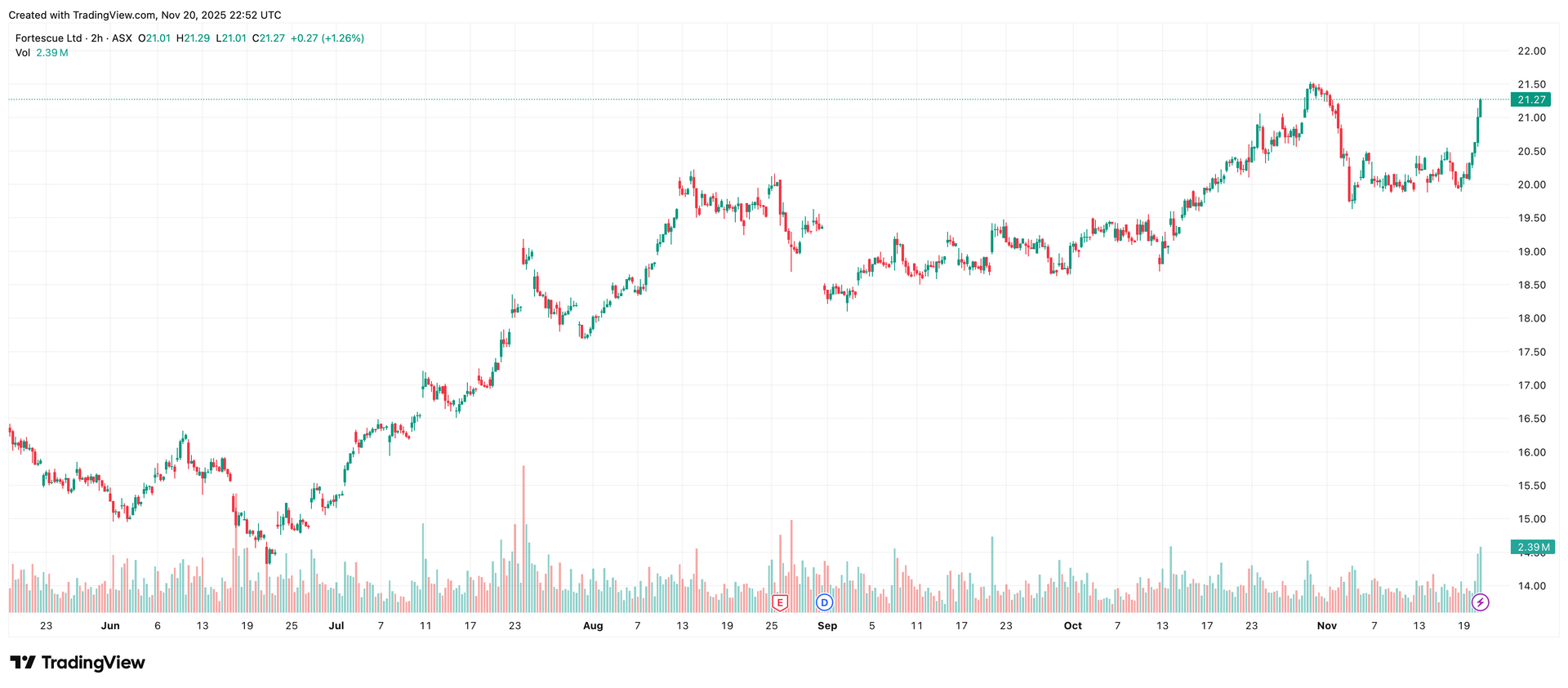
Since listing, Fortescue’s share price has climbed dramatically, reflecting both operational progress and the ups and downs of the iron ore market. Over the past decade, FMG’s share price $21.22 has moved broadly in line with iron ore price trends, often outperforming the ASX 200 during the upswings in commodity prices.


During periods of high iron ore prices, such as 2020–2021, Fortescue delivered record profits and dividends, driving its market capitalisation above $65.34B. That said, FMG’s price can swing sharply in line with commodity market volatility, which is all too often part and parcel of investing in resource companies. 


By comparison, Fortescue’s performance often runs parallel to that of BHP and Rio Tinto. That said, it has stood out with operational agility and higher dividend payout ratios. The stock tends to closely follow China’s industrial output and infrastructure investment, which means macroeconomic shifts in Asia can quickly affect investor sentiment in FMG.

Growth Potential

Fortescue’s iron ore operations remain the core of its earnings. It is the longer-term growth outlook that depends on branching out and evolving into new areas of innovation. 


Expanding Mining Capacity


The company is exploring new mining hubs within Western Australia to sustain production levels. Small, ongoing investments in efficiency, automation, and logistics are all designed to maintain Fortescue’s low cost-per-tonne advantage, which helps to mitigate market volatility.


Transition to Green Energy


Under its Fortescue Energy arm, the company is building a multi-gigawatt portfolio of renewable projects aimed at enabling and powering future hydrogen production.


Partnerships


Fortescue’s partnerships with technology firms and energy companies boost its focus on research and development. Collaborations in such areas as hydrogen technology, electrolyser manufacturing, and renewable integration may open new commercial opportunities and new sources of additional revenues.


Together, these initiatives show how Fortescue is evolving from a pure mining play into a diversified energy group with ambitions that extend well beyond just its core competency of iron ore.


Upcoming Innovations from Fortescue Ltd


  1. Green hydrogen production – The company is developing large-scale hydrogen projects, for example, the Gibson Island project in Queensland. It is also involved in international ventures aimed at exporting hydrogen to global markets.
  2. Renewable-powered operations – Fortescue has committed to achieving net zero operational emissions by 2030, replacing diesel in its mining fleets with renewable alternatives and electrified equipment.
  3. Technology and automation – The use of autonomous haulage, AI-driven maintenance systems, and advanced exploration technologies continues to boost productivity and safety across its sites.
  4. Sustainable supply chains – FMG is working towards traceable, low-carbon iron ore and also green steel initiatives, appealing to environmentally conscious investors (especially institutional investors) and industrial clients alike.


Fortescue continues to showcase how mining profitability and sustainability can move hand-in-hand.


FMG Shares Returns & Investor Sentiment


Over the past decade, Fortescue’s strong dividends and periodic share price surges have delivered solid overall returns for shareholders.

  • Dividend performance: Fortescue’s payout ratio has remained high relative to its peers, with average dividend yields often above the ASX 200 average. However, dividends can vary with the cyclical nature of iron ore prices.
  • Capital growth: Long-term investors who held FMG since its early 2010s expansion have benefited from its substantial, continued share price growth.
  • Market sentiment: Investor sentiment often reflects the expectations for Chinese demand and global steel production. FMG’s emerging ESG credentials have also attracted interest from sustainability-focused funds.


As of 21 November 2025, analyst consensus remains mixed, reflecting the balance between Fortescue’s green energy ambitions and shorter-term commodity price risks.


Investment Tips for Buying Fortescue Ltd Stocks (ASX:FMG)


Anyone looking to invest in Fortescue might benefit from taking a long-term, disciplined approach to the stock.

  • Evaluate valuation: Review price-to-earnings ratios, dividend yields, and iron ore market forecasts and compare the performance to FMG’s peers before committing capital.
  • Understand cyclical exposure: Iron ore prices are highly cyclical and can greatly influence ongoing earnings. One option to help you mitigate that risk is to consider active portfolio diversification.
  • Dividend reinvestment: Investors may also wish to consider reinvesting dividends to compound returns over time.
  • Track sustainability progress: Fortescue’s transition to green energy could significantly impact future valuation metrics. With the increased wave of reporting requirements for ESG globally, this trend could present some interesting opportunities for growth. 
  • Use reliable tools: Make sure you are able to actively monitor FMG’s share price, performance charts, and analyst commentary through trusted share advisories like Sharewise. See our free report on Mining Stocks.


By aligning research with professional insights, as an investor, you can make more confident decisions regarding FMG’s role in your broader portfolio.


Key Risks


  1. Commodity price volatility: FMG’s earnings are heavily dependent on iron ore prices, which can fluctuate with global demand and supply conditions, especially with the nearest trading partners in Asia.
  2. Economic exposure: A slowdown in Chinese industrial output or infrastructure investment could have an impact on revenues.
  3. Operational risks: Mining disruptions, cost inflation, or technical setbacks can all affect operational and production efficiency.
  4. Regulatory and environmental risk: Stricter environmental regulations and carbon policies globally may increase associated compliance costs.
  5. Energy transition execution: While Fortescue’s green hydrogen ambitions are promising, these projects carry technological, financial, and commercial uncertainties. While FMG has been successful in executing on similar strategies, there can always be a variety of challenges when working with new, emerging technologies. 


Balancing these risks against Fortescue’s opportunities can help you as an investor to decide how much exposure suits your own portfolio requirements.

Frequently Asked Questions.

  • How has Fortescue’s dividend policy changed over the past decade?

    Fortescue has consistently focused on shareholder returns, increasing payout ratios as profitability arises. While dividends can vary with the global commodity cycles, FMG’s management has maintained a commitment to distributing surplus cash, where prudent.

  • What impact do global iron ore prices have on FMG’s share performance?

    FMG’s earnings are closely tied to iron ore prices. When prices rise, margins increase. When prices fall, profits and dividends may see a softening. Keeping an eye on iron ore prices helps to provide useful context when assessing FMG’s valuation.

  • How does FMG compare to other ASX-listed mining stocks in terms of risk and return?

    Compared with its peers, such as BHP and Rio Tinto, FMG typically offers higher dividend yields but can suffer from greater price volatility. Its smaller size and focus on iron ore have the potential to amplify the sensitivity to market cycles. Its energy diversification through new technologies could help improve the balance in the longer term.

  • What role do Fortescue’s green energy initiatives play in its long-term growth strategy?

    Fortescue Energy is central to the company’s future strategy, targeting leadership in renewable hydrogen and decarbonised solutions. These opportunities may provide longer-term growth beyond the iron ore market.

  • How sensitive is FMG to global economic conditions and Chinese steel demand?

    As China represents a major share of global steel production, any major changes in its construction and manufacturing sectors can affect FMG’s export volumes and pricing.

  • How can investors incorporate FMG shares into a long-term income and growth portfolio?

    FMG could be ideal as a balanced exposure within a diversified portfolio. It has the ongoing potential to provide income through dividends and share price growth during surges in commodity markets. Investors might want to consider this as part of their own risk tolerance and market outlook.

Stay ahead of the market with expert insights from Sharewise. Subscribe to receive weekly share price updates, ASX stock analysis, and research reports covering Fortescue Ltd and other leading Australian companies.

Subscribe to our newsletter

Disclaimer: This article does not constitute financial advice nor a recommendation to invest in the securities listed. The information presented is intended to be of a factual nature only. Past performance is not a reliable indicator of future performance. As always, do your own research and consider seeking financial, legal and taxation advice before investing.

Is a Share Advisor

right for you?

January 22, 2026
Dividends as strategy, not just yield. Discover how to structure diversified income portfolios for stability and growth in the years ahead.
January 22, 2026
AI investment is driving a new wave of US corporate bond issuance, reshaping financing trends and investor opportunities in the technology-led market.
January 22, 2026
Holding $300,000 in cash presents a distinct financial paradox. While the liquidity feels safe, the silent erosion of purchasing power via inflation guarantees a loss in real value over time. You have moved past the accumulation phase where simple savings habits suffice. You are now in the wealth preservation and acceleration phase. The strategic deployment of this capital determines whether it remains a stagnant safety net or becomes a dynamic engine for long-term growth, driven by data rather than speculation. This is not about chasing "hot picks" or speculative trends. It is about applying institutional-grade principles to your investment strategy. Whether you are a self-directed investor seeking validation or a time-poor professional requiring oversight, the deployment of $300,000 demands a structured, evidence-based approach. Why Keeping $300k in Savings is a Risk Many investors perceive a high-interest savings account as the ultimate safe haven, a behavioural bias known as loss aversion. While the nominal balance of your $300,000 remains constant, its "real value" - what that money can actually buy - is in a state of constant decline. The Inflation Tax : The Australian Bureau of Statistics (ABS) reported a 3.4% rise in the Consumer Price Index (CPI) for the year ending November 2025. This means if your $300,000 is not generating a post-tax return greater than 3.4%, you are effectively losing wealth every day. The Cost of Inaction : Holding $300,000 in cash during a high-growth period results in significant "lost opportunity costs". For example, in FY25, Sharewise’s ASX model portfolio delivered a +26.49% return compared to the market’s 10.21%. By remaining in a standard savings account (typically yielding 4-5% before tax), an investor would have missed out on substantial compounding growth. Taxation Erosion : Unlike shares, which can offer tax-effective franking credits, interest earned on cash is generally fully taxable at your marginal rate. For high-income professionals or business owners, this further reduces the "real" net return, often leaving the investor behind the rate of inflation. For a portfolio of this size, cash should be viewed strictly as a tool for short-term liquidity, not a vehicle for wealth preservation. To protect the legacy of your $300,000, the data suggests a transition toward growth assets that have historically outperformed the RBA cash rate. The Great Debate: $300k investment in Stocks vs. Real Estate While property is a visible asset, it is also a 'frozen' one. A $300,000 investment in real estate often traps you in a cycle of debt, maintenance, and illiquidity. In contrast, a diversified share portfolio offers agility. Liquidity is Freedom : You cannot sell a single room of a house to fund a lifestyle change, but you can liquidate portions of a share portfolio in days. Compound Efficiency : Unlike property, where high entry and exit costs eat into your returns, equities allow your full $300,000 to work immediately. Diversification : Instead of one address, you own pieces of global leaders—from the tech giants of the Nasdaq to the high-yield miners of the ASX. For decades, Australian investors defaulted to property. However, investing $300,000 in the current market presents structural challenges. In major cities, $300,000 is often only a deposit, concentrating your risk into a single, illiquid asset with high entry costs. The Case for Equities The greatest threat to a $300,000 portfolio isn't market volatility, it’s the missed opportunity of inaction. Every day your capital sits idle, you miss the compounding power of institutional-grade insights and exclusive corporate finance opportunities, such as IPOs and placements, that the public never sees.Waiting for the 'perfect' time often means watching the best growth windows close. Success isn't about timing the market; it's about time in the market, guided by technical data and professional oversight. Data supports the shift from cash to equities. For FY25, Sharewise’s ASX model portfolio delivered a +26.49% return , significantly outperforming the market benchmark of 10.21% . Allocating $300,000 into the share market offers immediate, low-cost diversification. Data supports this shift. By utilising professional share advisory, you gain the agility to pivot sectors as economic conditions change. The key investment strategies to consider
January 21, 2026
Holding $200,000 in cash often leads to an erosion of wealth over time. While the security of a savings account feels comforting, data from the Reserve Bank of Australia (RBA) confirms that inflation consistently reduces the purchasing power of idle money. You have successfully accumulated significant capital, yet the transition from a saver to an investor requires moving from capital preservation to strategic capital deployment. Determining how to deploy $200k involves understanding different market strategies. For instance, growth-focused investors often look toward a different set of data-driven indicators than those prioritising consistent yield through dividends. This guide draws on Sharewise analysis and institutional-grade research to help investors navigate market complexities with professional clarity. Defining Your Investment Horizon Effective deployment of $200,000 starts by defining the money's primary job: are you seeking Capital Growth to build net worth, or Passive Income to support your lifestyle? A growth-focused strategy prioritises compounding wealth through companies, often in global sectors like technology, that reinvest earnings to expand share price. Conversely, an income strategy targets consistent cash flow, leveraging the Australian market's high dividend yields and franking credits to generate tax-effective revenue that often outperforms cash or term deposits. Unlike investing in a single property, which dictates a rigid outcome, the stock market offers the flexibility to pursue a "Total Return" approach. This allows you to blend the aggressive growth potential of international markets with the defensive stability of ASX income stocks. By clarifying whether you need maximum accumulation or regular payouts, you can structure a portfolio that doesn't just store wealth, but actively works toward your specific financial milestones. Asset Class Analysis: Where is the Best Place to Put $200k? Stocks vs. Real Estate Real estate is a traditional Australian wealth builder, but $200,000 is no longer a substantial deposit in many major markets. While real estate is a proven asset class, it comes with structural "frictions" that the stock market does not. Higher entry barriers: Entering the property market with this amount often requires significant leverage, which increases your risk profile. Illiquidity: Property can take months to sell. Shares can be converted to cash in T+2 days, giving you the flexibility to react to life changes or better opportunities. Lack of diversification: A property investment ties your $200,000 to one single address and one local economy. The stock market allows you to spread that same capital across hundreds of high-quality companies globally, reducing the risk of a single point of failure. Conversely, an investment in stocks offers immediate liquidity and diversification. You can split capital across various sectors or global markets. If you desire property exposure without the management of tenants, Real Estate Investment Trusts (REITs) provide commercial property exposure and regular income distributions while maintaining the liquidity of shares. Stocks vs. Term Deposits and Savings Many Australians view a high-interest savings account as the ultimate safe haven. However, for a $200,000 portfolio, "safety" can be a mathematical illusion. When you account for the Consumer Price Index (CPI) which rose 3.4% in the 12 months to November 2025 and the tax paid on interest earned, the "real" return on cash is often negative. Erosion of Purchasing Power : If your bank interest doesn't outpace inflation and tax, your $200,000 buys less every year. Opportunity Cost : While cash feels secure, it lacks the compounding growth potential found in equities, where historical returns have significantly outperformed the RBA cash rate over the long term. Term deposits offer safety from market loss but expose you to shortfall risk, where returns fail to keep pace with the cost of living. Investing in the share market involves fluctuation, but it historically provides returns that exceed inflation. For an investor with a long timeline, the perceived safety of cash often guarantees a decline in real value over time. Balancing the ASX with the Nasdaq and NYSE A common strategic error for Australian investors is "home bias"-over-allocating capital to the local market. While the ASX offers excellent franked dividends, it represents less than 2% of the global equity market and is heavily concentrated in the banking and mining sectors. By limiting a $200,000 investment to Australia, you may miss the aggressive growth engines of the global economy, specifically in technology and healthcare. Sharewise analysis suggests a blended approach: ASX Exposure : Utilised for defensive income and tax-effective yield through the imputation credit system. US Markets (Nasdaq/NYSE) : Accessed to capture capital growth from global leaders in tech and innovation. Professional Oversight : Our Chief Investment Officer (CIO) monitors 5,000 stocks daily across all markets, ensuring your $200,000 is positioned where the data indicates the strongest growth potential, not just where it is familiar. The key investment strategies to consider
January 21, 2026
Inflation is currently eroding the purchasing power of cash at a rate that demands action. Sitting on $100,000 in a standard savings account feels safe, yet the real value of that capital decreases every single day that it remains idle. Holding six figures in investable assets places you at a critical juncture. You have moved beyond the accumulation phase of the early saver and entered the territory of the sophisticated investor. The decisions you make now regarding asset allocation, risk management, and professional oversight will dictate whether this capital compounds into a comfortable retirement or stagnates against the rising cost of living.  This guide explores the evidence-based strategies for deploying $100,000 in the current Australian market, comparing asset classes and examining the structural advantages of managed equities. I have $100k to invest: What should I do? The "best" place to put $100k depends entirely on your timeline and risk tolerance. While the allure of a "safe" bank account is strong, safety is relative. The Australian Bureau of Statistics (ABS) reported a 3.8% rise in the Consumer Price Index (CPI) over the twelve months to the June 2024 quarter. If your post-tax return on cash does not exceed this figure, you are technically losing wealth. Investors typically face three primary pathways for this sum: Defensive Assets: Term deposits and bonds. Growth Assets: Equities (Shares) and Property. Speculative Assets: Crypto and Venture Capital. For high-income earners and self-directed investors, the stock market often provides the optimal balance of liquidity and growth potential compared to the high entry costs of real estate. Best way to invest $100k for monthly income Retirees and income-focused investors often ask about the best way to invest $100k for monthly income. While term deposits offer certainty, they rarely offer inflation-beating growth. The Australian share market (ASX) is unique globally due to the imputation credit system. When you invest in high-quality, dividend-paying companies (often referred to as "blue chips"), you receive a share of the profits. Because the company has already paid corporate tax, the Australian Taxation Office (ATO) grants you a "franking credit" for that tax. This can significantly boost the effective yield of your portfolio. Comparing Income Vehicles: Term Deposits: Safe capital, low growth, fully taxable interest. Investment Grade Bonds: Lower risk than shares, generally lower returns than equities over the long term. Dividend Equities: Potential for capital growth plus income. A portfolio yielding 4% to 5% plus franking credits can outperform cash rates, though the capital value fluctuates. Our share advisors provide general advice to help investors understand how to maximise these franking credits within a model portfolio, supporting a strategy focused on consistent yield and transparency. Investing $100,000 in the stock market vs real estate The Australian property obsession is well-documented, but investing $100k in real estate presents immediate logistical hurdles. In major markets like Sydney or Melbourne, $100,000 barely covers the stamp duty and deposit for a median-priced investment property. You become highly leveraged, meaning you owe significantly more than you own, and your asset is illiquid. You cannot sell a bedroom if you need cash flow. Investing $100,000 in the stock market offers distinct advantages: Liquidity: You can convert shares to cash in T+2 days. Diversification: Instead of one address, you own pieces of Australia’s largest banks, miners, and retailers. Yield: Australian shares often pay fully franked dividends, which can be more tax-effective than rental income. Entry Barriers: You can start deploying capital immediately without waiting for loan approval or settlement. For many investors, the stock market provides a more agile vehicle for wealth creation, particularly when the goal is to achieve market outperformance. For example, in FY25, Sharewise’s ASX model portfolio delivered a +26.49% return compared to the market’s 10.21%. Investing $100k in ETFs vs Managed Accounts Many self-directed investors default to investing $100k in ETFs (Exchange Traded Funds) or index funds. The argument is usually low fees and broad exposure. You buy the haystack to find the needle. While investing $100k in an S&P 500 ETF or an ASX 200 index fund guarantees you the market return, it also guarantees you catch every downturn. Passive funds do not discern between a good company and a bad one; they buy everything based on market cap. If a sector is overvalued, the ETF buys more of it. The Sharewise Managed Account difference: We believe in active risk management. A managed account provides the best of both worlds. You retain beneficial ownership of the shares (HIN based), meaning you see exactly what you own, but professional investment managers handle the day-to-day decisions including timely buy or sell actions pending your approval. Risk-Aware: We can move to cash to protect capital during volatility. ETFs stay fully invested while the market falls. Transparency: You are not just a number in a unit trust. You see every trade. Institutional-Grade Access: We utilise data and research typically reserved for institutional desks to identify opportunities before the broader market reacts. This approach suits the time-poor professional who wants the "investor" status without the administrative burden of researching individual stocks or rebalancing portfolios. Diversification: 100k investment in ASX vs NASDAQ and NYSE A common mistake for Australian investors is "home bias". The ASX represents less than 2% of the global equity market and is heavily skewed towards financials and materials. If you limit your $100k investment to the ASX, you miss out on the growth engines of the global economy: technology and healthcare. Investing 100k in S&P 500 vs ASX: ASX: High yield, lower growth, value-oriented. US Markets (Nasdaq/NYSE): Lower yield, higher capital growth, tech-heavy. A robust portfolio should not choose one or the other. It should integrate both. Gaining exposure to global giants (like Apple, Microsoft, or Nvidia) balances the cyclical nature of Australian miners and banks. Our advisors assist clients in constructing a blended portfolio that captures the defensive income of Australia and the aggressive growth of the US. The key investment strategies to consider Best way to invest $100k in the short term vs long term Time horizon is the single most important factor in your strategy. Short to Medium Term (3 years): For growth-focused investors, three years is ample time to target returns significantly higher than a term deposit. While passive funds can be risky in the short term because they are fully exposed to market dips, Sharewise’s active management is designed to solve this problem. Because we actively manage risk, moving to cash to protect capital during volatility rather than riding the market down, we can pursue high-growth outcomes over a medium timeframe. You do not need to settle for inflation-matching cash rates; you need a professional strategy that actively navigates the market to capture upside. Long Term (5 years+): History shows that equities outperform almost every other asset class over extended periods. The Vanguard Index Chart (2023) highlights that over 30 years, Australian shares have returned an average of roughly 9.2% per annum. While past performance is not a reliable indicator of future performance, the data suggests that time in the market is superior to timing the market. Making Your Decision Deciding how to invest $100,000 is a pivotal financial moment. It is the step up from saving to wealth building. You can leave it in the bank to slowly lose purchasing power, lock it away in an illiquid property, or deploy it into a liquid, diversified portfolio of high-quality companies.  At Sharewise, we don't believe in the 'silent broker' model. We provide proactive, one-on-one communication and active oversight. You won't have to wonder how your portfolio is performing; your dedicated advisor is accessible via call, text, or email to ensure your strategy remains responsive to the market. Ready to see how professional oversight can transform your $100k investment? We understand that trust is earned through results, not promises. To ensure you are comfortable with our professional investment management, Sharewise offers a 30-day non-committal period . This allows you to evaluate our performance and advisors risk-free before making a long-term commitment.
January 19, 2026
How Trump’s Greenland rhetoric and tariff leverage reshape geopolitical risk, critical minerals strategy, inflation expectations and portfolio positioning across global markets.
January 15, 2026
Finding balance in a shifting global liquidity environment as capital becomes more selective and market dynamics evolve.
January 14, 2026
How investors can handle market corrections with confidence, discipline and a long-term focus, even during periods of heightened volatility.
January 13, 2026
Navigate the 2026 commodities landscape covering energy, base metals and precious metals, with insights on strategic commodity investing.
January 12, 2026
A refreshed look at investing fundamentals, examining stocks, bonds and ETFs through modern portfolio construction and risk management.