Stock Spotlight: Goodman Group (ASX:GMG)
Goodman Group (ASX:GMG) has grown into one of Australia’s most prominent property groups, with an extensive international reach in logistics, warehousing, and industrial real estate. Over the past three decades, the company has transformed from a domestic property trust into a global giant with assets and partnerships across multiple continents.
For investors, GMG represents a way to participate in some of the most enduring trends shaping modern economies. These include the rise of eCommerce, the growing need for urban logistics, and the rising data centre infrastructure requirements to support the data-driven economies, such as Artificial Intelligence.
At Sharewise, we provide in-depth stock reports and portfolio insights to help investors assess companies like Goodman Group with clarity and balance.
About Goodman Group.
Goodman Group was established in 1989, originally operating as a small Australian property trust. Through strategic acquisitions, disciplined expansion, and a strong focus on logistics real estate, it has evolved into a global leader in the development and management of industrial property. Today, Goodman operates across more than a dozen countries, including Australia, New Zealand, Asia, Europe, the United States, and the United Kingdom.
The company’s business model rests on three interconnected pillars:
- Development: Goodman designs and constructs warehouses, logistics hubs, and industrial estates tailored to the needs of global tenants.
- Property investment and management: generating income streams from long-term leasing arrangements and ongoing property management.
- Strategic partnerships: building long-term relationships with blue-chip tenants and institutional investors, including leading global brands in retail, eCommerce, automotive, and data-driven technologies.
It is Goodman’s focus on assets that underpin the global supply chain that sets it apart. As shopping habits shift online and businesses demand faster delivery times, Goodman’s network of last-mile distribution centres and strategically located warehouses plays a pivotal role in enabling eCommerce giants and logistics companies to operate efficiently.
What Makes GMG Shares A Strong Investment Choice?
Investors often point to a few key strengths that set Goodman apart on the ASX. Its core exposure to logistics real estate means that demand for its properties is tied to structural changes in the global economy, rather than purely cyclical property demand.
- Exposure to growth industries: Goodman’s properties support the needs of fast-growing sectors such as online retail, third-party logistics, automotive supply chains, and, increasingly, data centres, given this infrastructure powers AI by providing the massive computing power, storage, and energy infrastructure needed for training and deploying AI-based models.
- Global diversification: By maintaining a broad international presence, Goodman reduces its reliance on any single economy or region, creating resilience during downturns.
- Sustainability and innovation: Goodman has built a strong reputation as a sustainable developer, aligning its long-term strategy with ESG priorities that matter to institutional investors. This may increasingly become a major strength as the group continues to support energy-hungry data centres.
- Disciplined balance sheet management: Investors often highlight Goodman’s cautious approach to debt and capital allocation as a reason for its stability compared with peers.
The group has also built trust with income-focused investors. Its history of delivering consistent distributions, even during periods of volatility in global property markets, gives it a reputation for stability and prudence.
Key Stats
Key Stats
Source: EODHD. Data as of 05/03/26.
Price Performance
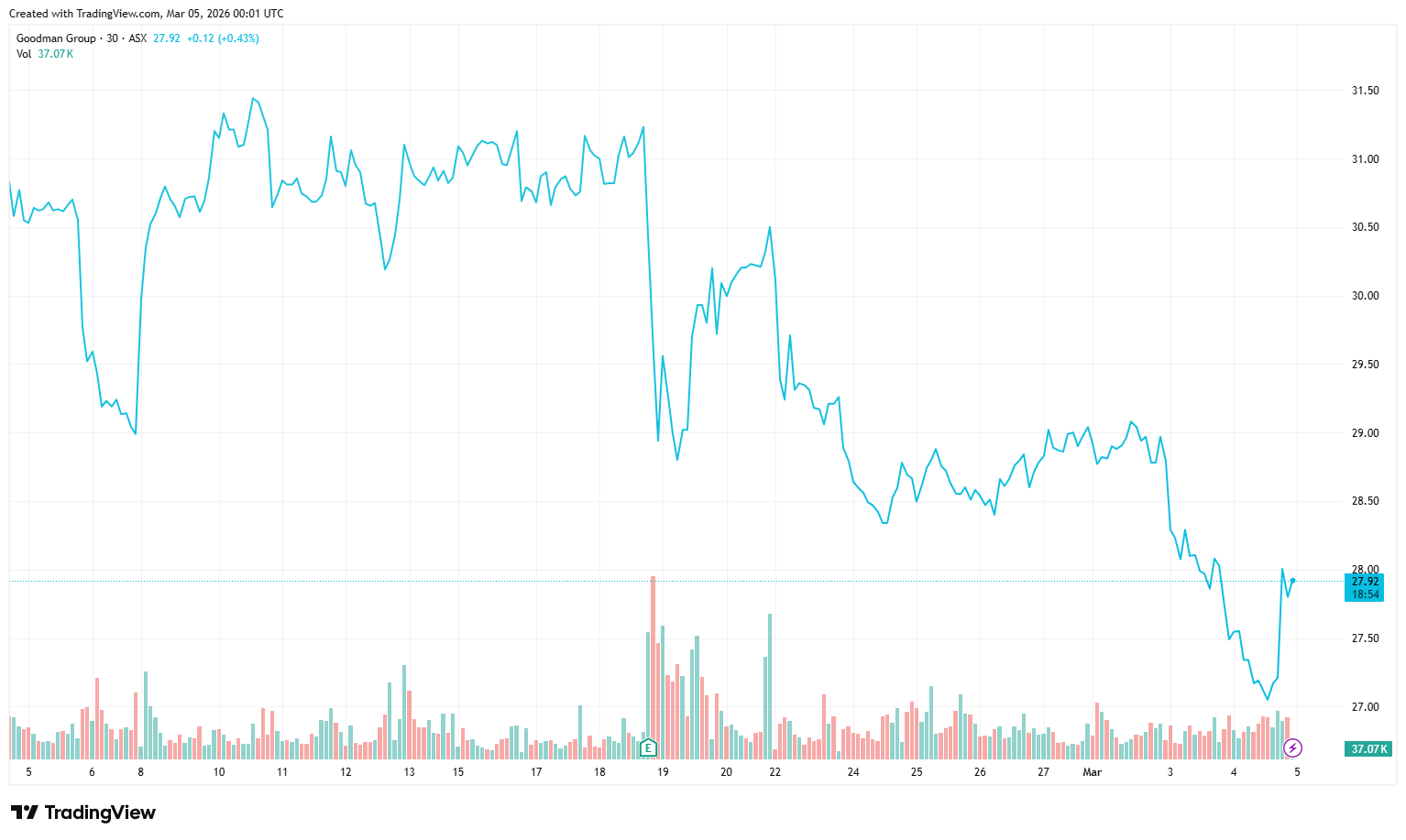
Over the past decade, Goodman Group’s share price has consistently outpaced the broader Australian property index. While cyclical challenges such as interest rate movements and inflation have introduced volatility, the company’s diversified international portfolio has often provided a cushion. Its performance is notable when compared with office or retail-focused REITs (Real Estate Investment Trusts), which have faced more structural challenges in recent years.
For example, as the demand for retail property has been impacted by online shopping, Goodman’s focus on logistics has allowed it to benefit from that very same trend. This structural alignment has contributed to Goodman’s share price being more resilient than some of its traditional property peers.
Goodman’s recent price performance also appears to be increasingly aligning with the Data Centre infrastructure requirements that will be increasingly needed to support the ongoing growth in AI.
Investors tracking the GMG share price ASX today may notice that it remains sensitive to macroeconomic conditions, but long-term performance has reflected both income generation and capital growth.
Growth Potential
Looking ahead, Goodman’s growth prospects are shaped by several long-term shifts:
- GMG’s high-quality investment portfolio which is globally diversified and gives exposure to developed and emerging markets.
- Strong property fundamentals which should see valuation uplifts.
- GMG could deliver attractive development margins on data centres, which provides a significant growth runway.
- With more than 50% of earnings derived offshore we expect GMG to benefit from FX translation and a prolonged period of lower rates.
- Transitioning to longer and larger projects in development
- Strong performances in Partnerships such as Cornerstone.
- GMG’s solid balance sheet providing firepower and access to expertise to move on opportunities in key gateway cities with demand for logistics space (and supply constraints) and diversify risk by partnering (i.e. growth in funding its development pipeline) or co-investment in its funds and or make accretive acquisition opportunities.
Upcoming innovations from Goodman Group
Goodman has invested heavily in sustainable development and advanced logistics infrastructure. Recent initiatives include:
- Carbon-neutral projects: Integrating renewable energy, such as rooftop solar, into its new facilities.
- Smart building technologies: Improving operational efficiency and reducing energy costs for tenants.
- Digital platforms: Upgrading tenant engagement and management systems to improve customer experience.
Together, these projects underline Goodman’s ambition to remain a leader in sustainable industrial property. Its commitment to environmental and technological innovation is not only a response to regulatory pressures but also a differentiator in attracting long-term tenants and investors.
GMG Shares Returns & Investor Sentiment
Goodman Group has delivered a strong blend of income and capital growth.
In FY24, operating EPS rose 14% to 107.5c, while distributions were maintained at 30c per security. Occupancy reached 97.7% with a $13.0bn development pipeline, helping drive a one-year TSR of 74.9% and 149.4% over five years.
Into FY25, Goodman reported 96.5% occupancy, $13.7bn work-in-progress with data centres making up more than half of projects, and reaffirmed EPS growth guidance of 9% alongside a stable 30cps distribution.
Compared with the broader A-REIT sector, where five-year annualised returns average ~13% per annum, Goodman’s outsized performance highlights its resilience and scale, with it representing ~41% of the index.
Market sentiment remains positive, supported by Goodman’s sustainability initiatives and strategic focus on AI-driven data centre demand. While management notes some macroeconomic uncertainty, the company’s discipline and exposure to long-term growth themes continue to underpin investor confidence.
Historically, Goodman has provided a combination of income and capital growth, which has appealed to a broad investor base. Over the past decade, investors have seen both consistent distributions and share price appreciation.
Analysts often cite its exposure to high-demand property types, its disciplined approach to development, and its ESG leadership as key reasons for its premium valuation compared with other REITs. Earnings updates tend to highlight high occupancy levels and stable rental income streams, which have bolstered investor confidence.
Investment Tips For Buying Goodman Group Stocks (ASX:GMG)
For those considering GMG shares, there are a few points worth keeping in mind:
- Valuation checks: Compare Goodman’s P/E ratio and price-to-book value with those of other REITs to understand relative pricing.
- Distribution track record: GMG’s dividend history shows a pattern of steady, sustainable payouts rather than aggressive hikes.
- Diversification strategies: Some investors hold GMG alongside infrastructure stocks and other industrial REITs for balance.
Long-term holding approach: Given the structural demand trends Goodman is exposed to, many view it as a long-term hold rather than a shorter-term play.
Key Risks
Investors should also weigh the risks that come with owning GMG shares, such as:
- Any negative changes to cap rates, net property income.
- GMG’s share price is now more linked to the AI trade.
- Any changes to interest rates/credit markets.
- Any development issues such as delays.
- Adverse movements in multiple currencies for GMG such as BRL, USD, EUR, JPY, NZD, HKD and GBP.
- Any downward revaluations.
- Poor execution of M&A or development pipeline.
- Key man risk in CEO Greg Goodman.
Balanced analysis of both risks and opportunities is important for any investor considering a position in GMG.
Frequently Asked Questions.
How has Goodman Group’s distribution policy evolved over the past decade?
Goodman has focused on maintaining steady, sustainable distributions. Rather than chasing short-term increases, the group has prioritised long-term payout stability, which has helped to build trust with investors.
What impact do Goodman Group’s global developments & strategic partnerships have on its share price?
International expansion and strategic tenant relationships often provide stability and resilience, which may support share price strength over time. The rising trend of data infrastructure requirements is an area to watch closely, especially given GMG’s increasing exposure to this sector, associated with increased focus globally on AI.
How does GMG compare to other ASX-listed REITs in terms of risk & return?
Compared with retail or office REITs, Goodman has more direct exposure to logistics and industrial property, sectors that many investors consider are better aligned with modern economic shifts globally.
How sensitive is Goodman Group to interest rate changes & global economic conditions?
As a capital-intensive business, GMG is affected by borrowing costs and broader economic cycles. Rising interest rates or global slowdowns can influence both tenant demand and property values.
What ESG (environmental, social, governance) initiatives are shaping Goodman Group’s long-term strategy?
The company has committed to carbon-neutral developments, renewable energy integration, and responsible governance frameworks. These initiatives may also help attract long-term institutional capital.
How can investors use GMG shares as part of a long-term income & growth strategy?
Some investors view GMG shares as a way to balance income and capital appreciation. However, portfolio decisions should always be considered within the broader context of diversification, individual investment goals and risk tolerance.
If you are considering investing in Goodman Group or other ASX-listed stocks, professional insights may help you make more confident decisions. Sharewise offers access to institutional-grade research and portfolio tools designed for self-directed investors and SMSF trustees.
Speak to one of our expert advisors to learn
more.
Subscribe to our newsletter
Disclaimer: This article does not constitute financial advice nor a recommendation to invest in the securities listed. The information presented is intended to be of a factual nature only. Past performance is not a reliable indicator of future performance. As always, do your own research and consider seeking financial, legal and taxation advice before investing.
Speak to an Advisor