UAE’s Exit From OPEC: A Structural Shift in How Oil Markets Are Priced
From Signal to Reality
For years, fractures within OPEC were discussed as a theoretical risk rather than a priced reality. The United Arab Emirates’ (UAE) long-standing frustration with production quotas was well understood, its investment in expanding capacity was visible, and its divergence from the cartel’s strategic direction was evident in the data. None of it resulted in a decisive break until now.
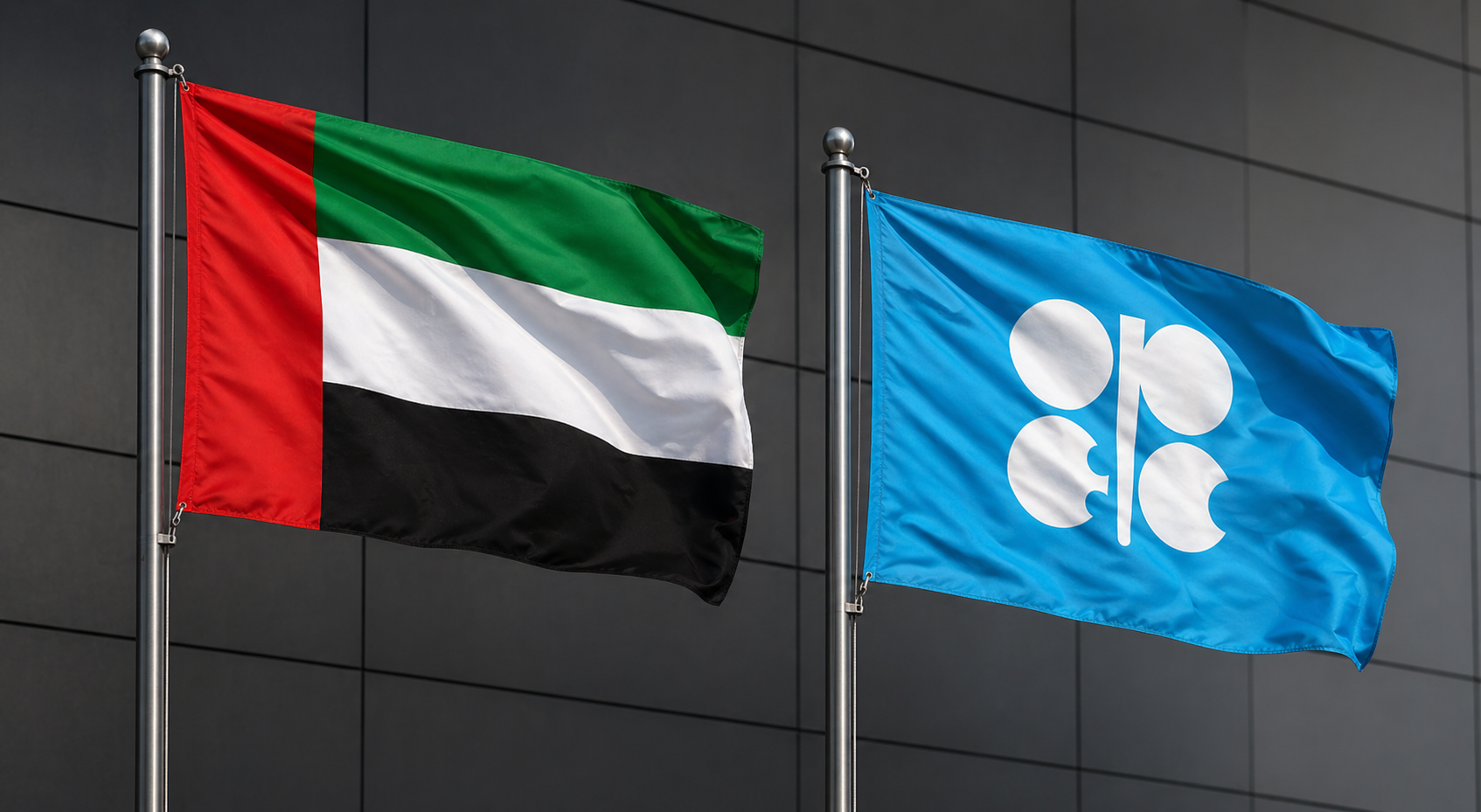
Effective 1 May 2026, the UAE will withdraw from OPEC and the broader OPEC+ alliance, which includes Russia and other non-member producers. The decision reflects a deliberate shift in national strategy, driven by long-term economic priorities and an evolving energy profile rather than short-term geopolitical developments. Yet the immediate market reaction has been notably muted. Oil prices, already trading above USD110 per barrel amid the Iran conflict and disruption in the Strait of Hormuz, showed little response.
This absence of reaction is not a dismissal of the event’s importance. It reflects current supply constraints. With the Strait of Hormuz effectively restricted, a significant portion of global oil flows, including UAE exports, cannot move freely. Under these conditions, the UAE’s exit does not alter near-term supply dynamics because additional production cannot yet reach the market.
The near-term irrelevance of the decision makes its longer-term significance easier to overlook. This is no longer a question of whether OPEC might weaken. It is a structural shift in how supply may be managed going forward and a change in how investors should interpret oil market dynamics.
Why the UAE Walked Away
The UAE’s exit has been framed in some coverage as a response to Iran’s missile and drone attacks during the conflict. That characterisation has been explicitly rejected by policymakers. The energy minister described the move as a policy decision taken after a review of current and future production strategy, rather than a reaction to external events.
The economic case for leaving is longstanding. The UAE has been one of the most constrained members of OPEC, not because it lacks production capacity but because its capacity exceeds what the quota framework allows it to utilise. It has the ability to produce close to 4.9 million barrels per day, yet output has remained below that level in line with OPEC commitments. While other members have exceeded quotas with limited consequence, the UAE largely complied, leaving potential revenue unrealised in support of collective price discipline.
That constraint has become increasingly difficult to justify as capacity expands. The UAE is targeting production capacity of 5 million barrels per day by 2027 and has indicated that it could reach 6 million barrels per day if required. This positions it among the largest global producers. Exiting OPEC removes the quota limitation that stood between current production levels and that ambition.
The broader context provides additional perspective. Differences between the UAE and Saudi Arabia have become more visible across economic and regional issues, while Iran, also an OPEC member, has conducted direct attacks on UAE territory and shipping during the conflict. The UAE’s official position remains that the decision is economic. The surrounding developments form part of the broader backdrop.
Taken together, the evidence points to a country with expanding production capacity, a clear incentive to increase output and a policy framework that no longer aligns with its strategic objectives.
What Changes Immediately
The most accurate answer to what changes on 1 May is very little in the near term. Current oil prices remain elevated due to disruption in the Strait of Hormuz, which continues to constrain global supply flows. That same constraint limits the UAE’s ability to increase production regardless of its OPEC status. Until export routes normalise, additional capacity cannot be fully utilised.
The economic impact of the exit therefore does not occur at the point of announcement, but when logistical constraints ease and production can be increased. The timing of that transition is critical for how the market responds.
What does change immediately is the signal. OPEC’s influence has historically relied on the credibility of its production commitments and the spare capacity available to enforce them. The UAE’s departure affects both. A member that adhered to quotas has chosen to leave the framework, altering the incentive structure for those that remain.
The shift is also material from a capacity perspective. Saudi Arabia and the UAE together have represented a significant share of global spare production capacity. With the UAE no longer part of the coordinated system, Saudi Arabia becomes the primary swing producer. This concentrates influence while reducing the breadth of coordinated capacity available to stabilise the market.
From Coordination to Competition
The UAE’s exit raises a structural question that extends beyond its own production ambitions. If one of the most compliant and capacity-rich members of OPEC has determined that independent production maximisation better serves its interests than coordinated restraint, it changes how other members assess their own positions.
OPEC’s cohesion has been under pressure for some time, reflecting differences in economic priorities and production incentives. Countries with low costs and significant spare capacity have historically supported price discipline through output restraint. Others have had stronger incentives to prioritise volume, particularly where fiscal pressures are more immediate. These differences become more significant when a key participant exits the framework.
The UAE’s departure also affects how supply is managed. A large share of spare production capacity has historically been concentrated among a small number of producers. With the UAE no longer part of the coordinated system, Saudi Arabia assumes a more central role. While it retains the ability to influence supply, a system reliant on a single primary swing producer is less balanced than one supported by multiple participants.
The longer-term consideration is whether this shift changes behaviour across the group. Increased production outside quotas may encourage other members to reassess their participation or compliance. The outcome is uncertain, but the direction is clearer. The market is moving toward a more competitive supply environment with implications for price stability.
Oil Price Implications: Less Control, More Volatility
The price implications of the UAE’s exit operate across two timeframes. In the near term, the impact is limited. Oil prices above USD110 are being driven by supply disruption and geopolitical risk linked to the Strait of Hormuz and the Iran conflict, not by OPEC quota dynamics. The UAE cannot increase supply that cannot be transported.
The medium-term dynamic is more significant. Once shipping routes normalise and the UAE begins to utilise its expanded capacity, additional supply will enter the market without quota constraints. This would typically place downward pressure on prices. At the same time, demand conditions and geopolitical risks remain uncertain.
These competing forces point to increased volatility rather than a clear directional move. A less coordinated supply framework reduces the market’s ability to stabilise prices, making outcomes more sensitive to changes in production, demand and geopolitical developments.
For investors, the distinction between price level and price stability is critical. A world where oil trades at $85 with low volatility allows businesses, central banks and investors to plan with reasonable confidence. A world where oil trades between $70 and $120 depending on geopolitical developments and production decisions made by a less coordinated set of producers creates a structurally more uncertain planning environment for every oil-sensitive business and policy institution.
Market Implications: Winners, Losers and Second-Order Effects
The UAE’s exit extends beyond oil markets into broader financial conditions. Changes in energy pricing affect equities, inflation and policy decisions.
Industries with high fuel exposure stand to benefit if oil prices moderate over the medium term. Airlines and transport operators are the most direct beneficiaries, with fuel costs representing a significant portion of operating expenses. For example, Qantas has already experienced a material increase in fuel costs, and any reversal in oil prices would support margins and capital return capacity. Consumer-facing businesses with significant logistics and freight exposure would see similar cost relief. At a macro level, energy-importing economies such as Australia, Japan and much of Europe benefit through lower input costs, reduced inflationary pressure and improved current account dynamics.
Pressure points emerge on the supply side. Higher-cost producers, including US shale operators, Canadian oil sands and deep-water projects, face margin compression in a more competitive pricing environment. The UAE’s low production cost base allows it to operate profitably at lower price levels, sustaining output through cycles that would force higher-cost producers to reduce supply. Oil-dependent economies also face a more challenging fiscal outlook if collective price support weakens, particularly where government budgets are closely tied to energy revenues.
Energy equities reflect this tension. Elevated oil prices have supported earnings across producers, including Woodside Energy and Santos Ltd. A shift toward lower or more volatile pricing introduces earnings revision risk, particularly for companies priced on sustained high oil assumptions. At the same time, increased volatility can create opportunities within the sector, influencing capital allocation and investor positioning.
The macro effects are equally important. Oil prices influence inflation and central bank policy. For Australian investors, this includes the outlook for the Reserve Bank of Australia, household costs and sector rotation within the ASX. The implications extend across asset classes. This is not simply an energy story. It is a macroeconomic shift with cross-asset implications, influencing everything from corporate margins to interest rates and portfolio construction.
What This Means for Investors
Expect higher oil price volatility and position accordingly. The shift from coordinated supply management to more competitive production increases uncertainty. For energy sector exposures, this means wider earnings ranges and less predictable dividend outcomes. Companies with low costs and strong balance sheets are better positioned than those reliant on sustained high prices.
Reassess energy exposure across structural and cyclical dimensions. The recent energy rally has been driven by geopolitical disruption, which is temporary. The UAE’s production strategy is structural. Investors need to assess whether current positioning reflects that shift in medium-term dynamics.
Watch the macro spillovers for the broader portfolio. Oil prices influence inflation, central bank policy and currency movements. For Australian investors, this includes the trajectory of the Reserve Bank of Australia, household fuel costs and sector rotation across the market. The reopening of the Strait of Hormuz is the key trigger that moves the UAE’s production capacity from a constrained factor to an active supply driver.
A Market Without a Clear Anchor
The UAE’s exit is not simply a supply adjustment. It marks a shift in how the market interprets OPEC’s role in shaping global oil prices. The organisation remains relevant, but the assumption that it can consistently anchor supply and stabilise pricing is becoming less certain.
The structure that has underpinned oil market stability for decades is evolving. Coordination is giving way to divergence as member incentives move further apart. Production decisions are increasingly influenced by national priorities rather than collective discipline, reducing predictability.
Markets are adjusting to this change. Oil prices will continue to reflect supply and demand, but the mechanisms governing supply are becoming more fragmented. That fragmentation introduces a wider range of outcomes and greater sensitivity to change.
The key question for investors is no longer whether OPEC can influence prices. It is how much that influence matters in a market that is becoming less dependent on coordinated action.
Subscribe to our newsletter
Disclaimer: This article does not constitute financial advice nor a recommendation to invest in the securities listed. The information presented is intended to be of a factual nature only. Past performance is not a reliable indicator of future performance. As always, do your own research and consider seeking financial, legal and taxation advice before investing.
Speak to an Advisor